Uniform wall thickness is a key principle in injection molding, but many parts naturally contain thicker sections that can lead to unnecessary material usage and defects. Coring helps remove these excess areas without compromising the part’s performance. If you’re designing plastic parts for manufacturing, understanding coring and applying it correctly is essential for creating parts that are more cost-effective and less prone to defects.
What Is Coring in Injection Molding?
Instead of molding a solid block of plastic, coring creates hollow or recessed sections within thick areas of a part. This approach maintains the required shape, strength, and function while reducing unnecessary material usage.
For example, a screw boss designed as a solid cylinder would create an unnecessarily thick section. By adding a core pin to create a hollow center, the design reduces material usage and shrinkage risk while maintaining the boss’s required dimensions and screw engagement.

How to Core a Part
Coring is not a single action. It is a design process that runs from initial concept through to mold construction. Here is how it typically works in practice.
- Identify thick sections: Review the part design to locate areas that exceed the nominal wall thickness, such as bosses, ribs, handles, and brackets, using CAD thickness analysis tools.
- Define the target wall thickness: Establish an appropriate wall thickness, typically around 50–70% of the nominal wall thickness, to balance structural requirements and shrinkage control.
- Remove unnecessary material: Modify the feature geometry by creating shells, cavities, or internal voids to reduce excessive thickness while maintaining required functionality.
- Apply draft angles: Add 0.5–2° of draft to surfaces formed by core pins or lifters to ensure smooth part ejection.
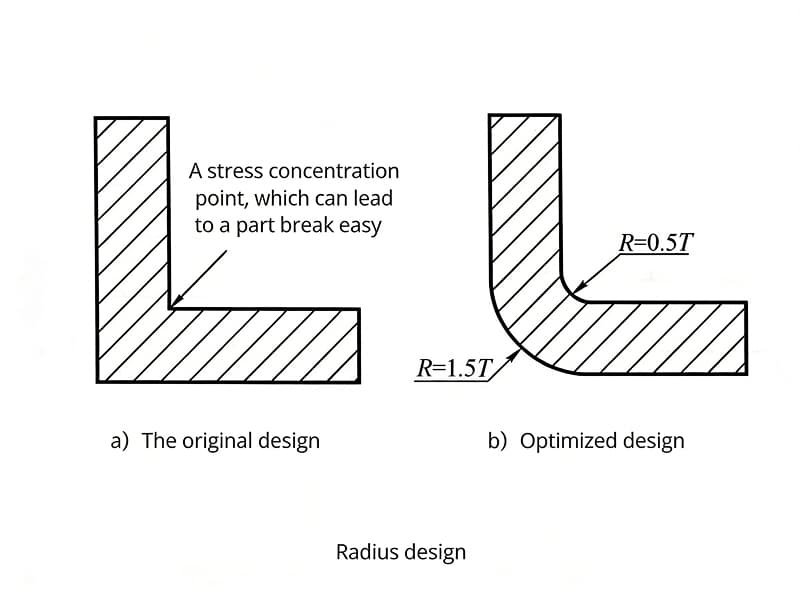
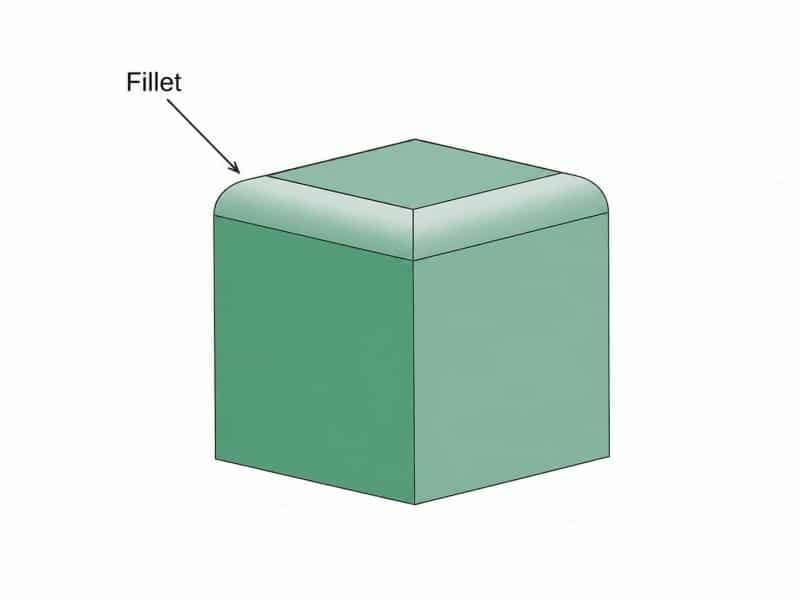
- Add fillets to internal corners: Round internal transitions to reduce stress concentration and improve material flow during molding.
- Incorporate the core design into the mold: Select an appropriate core solution based on part geometry and tooling requirements.
- Validate the design before tooling: Confirm wall thickness ratios, core pin aspect ratios, and draft requirements through DFM review or mold flow analysis before mold fabrication.
Where Coring is Applied
Coring can be applied to various part features where reducing unnecessary solid sections helps improve manufacturability while maintaining the required function and performance.
Bosses
Bosses are cylindrical features commonly used for screws, standoffs, or alignment pins. When molded as a solid feature at the base of a wall, the boss forms a local mass that’s significantly thicker than the surrounding nominal wall. Coring removes material from the center of the boss, leaving a hollow cylinder with a wall thickness close to the part’s nominal wall, typically 50–60% of the base wall thickness.
Ribs
Ribs are often increased in height or thickness to improve part stiffness and load-bearing capability. Standard rib design keeps thickness at roughly 50–60% of the adjoining wall to avoid creating a thick section at the base. When a rib’s structural requirements call for greater thickness or a wide base, coring keeps each section within that ratio while still delivering the needed stiffness.
Handles and Housings
For larger ergonomic or structural features such as handles, brackets, and housings, coring converts the originally heavy solid mass into a shell structure with a defined wall thickness, typically reinforced internally with ribbing or gusseting to carry the load the solid section would have provided.
Holes and Cavities
Some coring exists purely for function rather than wall-thickness control. For example, designing through-holes, blind holes, and internal cavities into the part to accommodate fasteners, alignment pins, wiring, mating components, or fluid paths.
Why Coring Is Important
By addressing the challenges caused by unnecessarily thick sections, coring provides several benefits that improve part quality, manufacturing efficiency, and overall product performance.
Cleaner Cosmetic Surfaces
By reducing excessive material in thick sections, coring helps minimize large variations in wall thickness. This allows the part to cool and shrink more consistently, reducing visible sink marks on cosmetic surfaces.
Lower Part Weight
Removing material from thick sections directly reduces the finished part’s weight, benefiting weight-sensitive applications such as automotive and consumer electronics. Lighter parts also reduce material handling requirements and shipping costs in high-volume production.
Lower Material Cost
By reducing unnecessary material in thick sections, coring lowers the material required for each part. Over large production volumes, these material savings can contribute to lower overall manufacturing costs.
Better Long-Term Durability
Cored, uniform walls minimize the residual stress that solid sections lock in as they cool unevenly, improving the part’s structural reliability over its service life.
More Consistent Quality
Uniform wall thickness makes the molding process more stable. Less variation in fill pressure, packing, and cooling means fewer rejected parts and tighter dimensional control.
Design Considerations for Coring
Carrying out coring correctly depends on more than a single wall-ratio rule. A few angles worth weighing for parts:
Material Flow Behavior
Some materials may have difficulty filling long and thin cored sections, which can result in short shots or weld lines at the end of a boss or rib. In addition to thickness analysis, flow simulation is also required to verify that the geometry can be filled completely.
Functional Requirements
Cored features must be designed around the functional requirements of the part. For example, for a screw boss, the diameter and depth of the cored hole must match the required screw engagement and pilot hole specifications. A structurally optimized coring design will not perform properly if the resulting hole dimensions do not meet the fastener requirements.
Interference between Nearby Core Mechanisms
Multiple cored features located close together may require separate core pins, lifters, or slides. These mechanisms must be properly arranged within the mold to avoid interference and ensure sufficient clearance during operation.
Core Pin Wear
Core pins can experience wear or develop flash after repeated molding cycles, gradually affecting the dimensions of the cored feature. High-volume production should account for potential dimensional changes over the tool’s service life.
Conclusion
Coring is a simple but effective design approach that can significantly improve the quality and cost efficiency of injection-molded parts. By transforming thick and solid sections into more uniform wall structures, it helps prevent sink marks, reduce cycle time, and improve dimensional stability while maintaining the part’s required function and appearance.
If you are unsure whether your design fully utilizes coring, our DFM review can identify potential improvements before tooling. Contact Erye’s engineering team for a free DFM analysis and learn more about our injection molding services.