The Complete Guide to Fillet Machining for CNC Parts

Fillet
In This Article
    添加一个标题以开始生成目录
    Scroll to Top

    Fillet machining turns a sharp internal corner into a smooth and rounded transition, and that small changes how a part performs. Fillets were added to stop cracks, ease stress, and keep parts from failing right where two surfaces meet. This guide will tell you what a fillet actually is, the types of it, how a CNC machine cuts it, and why you use fillets in CNC Machining.

    What Is a Fillet in CNC Machining?

    A fillet is a rounded corner, usually on the inside of a pocket, slot, or where a wall meets a floor. Instead of a crisp 90-degree edge, you get a smooth curve with a defined radius. That curve is not decoration. It helps reduce stress concentration caused by sharp geometry.

    Imagine a bracket under repeated load. If the inside corner is sharp, cracks tend to start exactly there, at the point of maximum stress concentration. With a 3 mm fillet at the same corner, the stress is distributed over a wider area. Under the same load, the service life of the parts will be extended.

    Fillet vs Chamfer

    These two terms are often confused, but they refer to different concepts. A fillet creates a smooth, curved transition between two surfaces, while a chamfer removes the sharp edge with a flat and angled surface, typically at 45 degrees.

    A chamfer is for edges you touch, such as the mouth of a hole, the top of a shaft, anywhere a sharp edge could cut a hand or catch a wire during assembly. A fillet is for corners that carry load, such as the inside of a bracket, the base of a rib, anywhere stress needs somewhere to go. For a detailed comparison, see our fillet vs. chamfer guide.
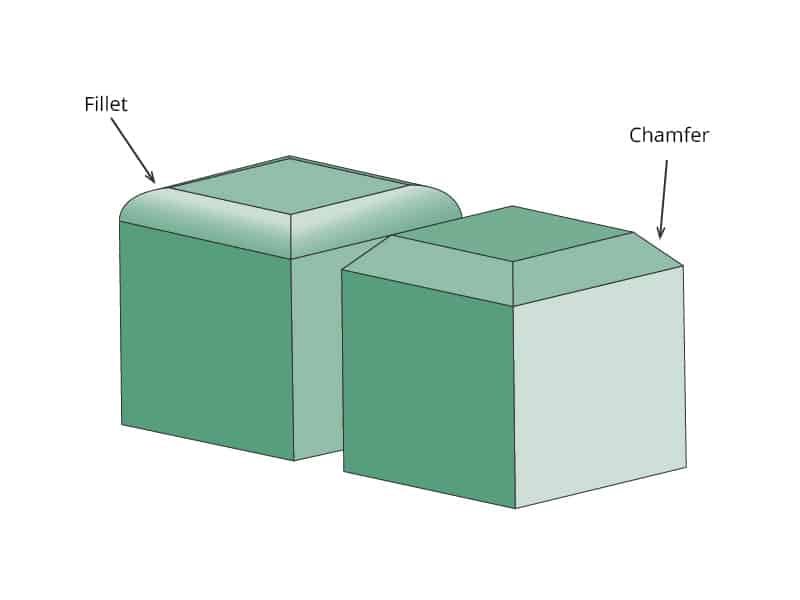
    Fillet vs Chamfer
    Fillet vs Chamfer

    Different Types of Fillets in CNC Machining

    Fillets generally fall into two categories: internal fillets and external fillets. The type of fillet affects both the design intent and how a CNC machine actually cuts it, so it is worth understanding the two types before using them.

    Internal Fillets

    Internal fillets, also called concave fillets, are the most common type. They are typically used where a vertical wall meets a horizontal floor inside a pocket, and their radius is governed directly by the radius of the end mill used to cut them. Because the tool has to reach inside a confined space, the achievable radius depends on the smallest tool that can safely get into the corner. Internal fillets help reduce stress concentration where two surfaces meet, preventing cracking under repeated stress or vibration.

    External Fillets

    External fillets, also called convex fillets, create a rounded transition along an outside corner or edge, such as a rounded enclosure corner. These are more flexible to produce, since the tool sweeps along an open edge rather than working inside a pocket. On exposed corners, they offer better resistance to chipping and general wear, and rounding off sharp edges makes a part safer to handle and less likely to snag on packaging or other components during assembly.

    How Fillets Are Machined in CNC Processes

    Fillets are created during normal milling operations but are often limited by tools in most applications. Common tools include flat end mills, ball end mills, and form cutters.

    Flat End Mills

    They are the standard tools for machining internal corners. As the tool cuts down into a pocket, it can only trace its own round shape at each inside corner, leaving a radius equal to the tool’s own radius. This is the cheapest way to get a fillet because there is no special tooling and no added setup.

    Ball End Mills

    They have a fully rounded tip and are the ideal choices for external fillets and rounded 3D contours. Because the tool follows an open edge rather than working inside a confined pocket, external fillets can accommodate a wider range of radii without significantly increasing machining complexity or cost.

    Form Cutters

    They are specially processed tools shaped to cut an exact and non-standard profile in a single pass. These tools are used when a design needs a tight tolerance or an unusual radius that no off-the-shelf tool can match. They are typically the most expensive tooling option.

    Erye CNC Machining Service

    Erye's CNC machining team will select the right tooling for every fillet, so your radius can remain clean and consistent on the first run.

    Why Do We Need Fillets When Machining?

    Fillets serve several important functions in machined parts, from reducing stress concentration to simplifying machining and improving assembly safety. The following factors explain why they are commonly used in part design.

    Stress Reduction

    Sharp internal corners will become points of stress concentration. Under load, cracks initiate at these points more often than anywhere else on a part. A fillet spreads that load over a curve instead of concentrating it at a single point, which directly improves parts’ fatigue life.

    Manufacturability

    From a DFM perspective, CNC cutting tools are round, so a sharp internal corner is often impossible to cut exactly as drawn. Adding a fillet matches the part’s geometry to the tool’s shape, letting the tool follow a smooth path instead of stopping at an unreachable edge. This simplifies tool selection and reduces the need for additional machining operations, leading to faster cycle times and fewer unexpected issues during production.

    Material Flow

    Sharp corners can trap air or cause uneven cooling in casting and molding. A fillet lets material flow more evenly, reducing the chance of voids or weak spots. It also creates a smoother transition between adjacent surfaces, which can help minimize abrupt changes in material thickness.

    Assembly and Safety

    Rounded edges are easier and safer to handle. A housing with filleted corners is less likely to chip during shipping, and it won’t cut into a technician’s hand during assembly. For frequently handled parts, these smoother transitions can improve both assembly efficiency and overall user safety.

    Tips for Achieving High-Quality Fillets

    Achieving consistent and high-quality fillets requires more than selecting an appropriate radius. Tool availability, radius consistency, component fit, and pocket depth all affect machining efficiency and the quality of the finished part.

    Standard Tool Sizes

    Match your fillet radius to a standard tool size whenever you can. Dimensions such as R2, R3, R5, and R6 line up with common end mill diameters and avoid custom tooling costs.

    Consistency

    Maintain consistency throughout the entire component. Mixing dozens of slightly different fillet radii on one design multiplies tool changes and setup time. Standardizing on two or three fillets can keep the job efficient.

    Mating Parts

    You should consider the mating part as well. If a fillet interferes with the fit between two components, you may need a relief cut or a smaller radius to ensure proper assembly.

    Deep Pockets

    For deep pockets, the fillet size should also be determined by the tool length, not just the diameter. A tiny fillet at the bottom of a deep pocket needs a long and thin tool. But such tools are more prone to deflection during machining. Increasing the fillet radius provides more clearance for a larger, more rigid tool, which can reduce tool deflection, vibration, and the risk of producing an out-of-specification finish.

    Common Applications of Fillet Machining

    Fillets are used in nearly every industry that relies on CNC parts.

    • Aerospace: Structural brackets, mounting flanges, and housings that see repeated vibration during flight.
    • Automotive: Engine components, transmission housings, and chassis brackets that go through constant thermal cycling and mechanical stress.
    • Medical devices: Surgical instrument components and implant housings, on both internal and external corners.
    • Consumer electronics: Consumer and industrial enclosures, with external fillets on outside corners and internal fillets on mounting bosses.
    • Industrial machinery: Gearbox housings, pump bodies, and structural frames that carry heavy, repeated loads.

    Conclusion

    Fillets are not added as an afterthought; rather, they are incorporated into the actual application process of the CNC parts. Matched tooling and thoughtful radius choices all work together to turn a sharp and vulnerable corner into a smooth transition that carries load and resists cracking.

    If you’re unsure which fillet radius fits your geometry, tooling setup, or production volume, Erye’s CNC machining service can help you work through the trade-offs before the first cut is made.

    Share Article

    You May Also Like These Articles

    Bosses are one of the most common features in injection-molded plastic parts, providing essential functions

    Interference fits are used in demanding mechanical applications, from rotating shafts and pressure vessels to

    When conventional injection molding reaches its limits due to extremely small part size, complex geometries,

    When custom plastic components, we often see a machine parameter, such as a “100-ton press”

    Countersink vs. counterbore is a common point of confusion in machining and product design. Both

    Compared to traditional materials such as metals, ceramics, and laminated glass, plastic has the disadvantage

    Online Message

    If you are interested in our products, you can leave us a message via the form below and we will get back to you within 8 hours!