
Precision molds play a critical role in the dimensional accuracy, repeatability, and fit of injection-molded parts. For its design, the key question is not simply whether a mold can produce a part within tolerance once. The mold must also maintain that accuracy across repeated cycles, material changes, and normal wear. This article takes a closer look at what makes a mold truly precise, from design and material choices to quality control and the technologies shaping its future.
Understanding Precision Molds
A precision mold is designed to produce plastic parts with consistent dimensional accuracy, often within thousandths of an inch. To achieve this level of precision, computer-aided design (CAD) and computer-aided manufacturing (CAM) guide mold geometry development and machining. CNC milling, electrical discharge machining (EDM), or precision grinding then shape the cavity and core, refine complex features, and control critical dimensions.
A precision mold provides the foundation for precision injection molding, but it does not automatically make every dimension equally accurate. Part geometry, resin shrinkage, molding conditions, and measurement methods all affect the final result. A clear drawing, material specification, and list of critical-to-quality dimensions help define the requirements before tooling begins.
How Mold Design Influences Precision Mold Tolerance
Precision mold tolerance depends on how accurately the mold is designed and built. Cavity dimensions, core alignment, cooling layout, and ejection structure all influence whether the mold can consistently produce parts within the specified tolerance.
Cavity and Core Geometry
The cavity forms the part’s external surfaces, while the core creates internal features such as holes, ribs, and channels. So their dimensions and alignment need to match the drawing requirements. Precise positioning between these components helps maintain uniform wall thickness and prevents defects such as flash along the parting surfaces. Even a small offset can distort a thin section.
Mold design should also avoid unnecessarily deep cores, narrow slots, and small shut-off areas because they are more difficult to machine and inspect, making dimensional accuracy harder to maintain.

Cooling System Design
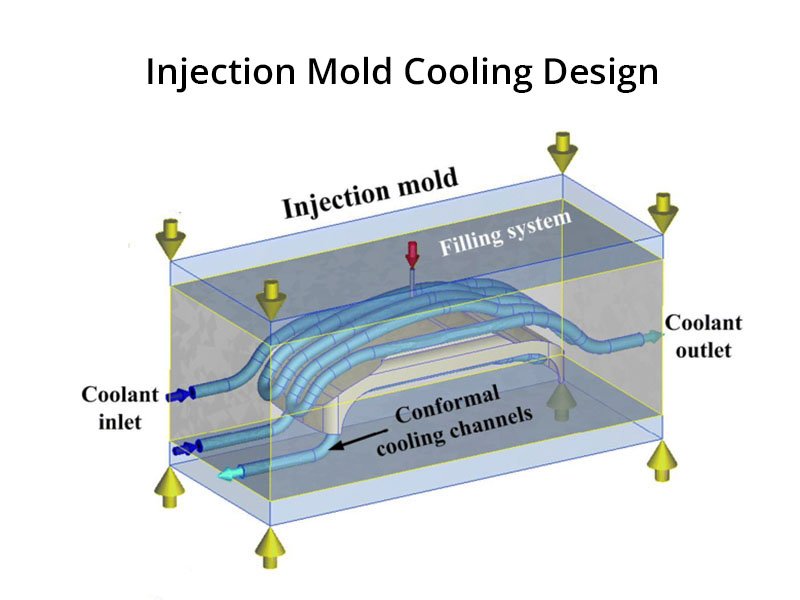
In precision mold design, the cooling system must maintain an even temperature distribution across the cavity to reduce warpage and dimensional variation. Cooling channel placement and resin shrinkage must also be accounted for when determining cavity dimensions. For example, a flat cover with thick mounting bosses may develop uneven shrinkage if cooling around these sections is insufficient, making it harder to achieve the required mold precision.
Parting Line, Venting, and Ejection
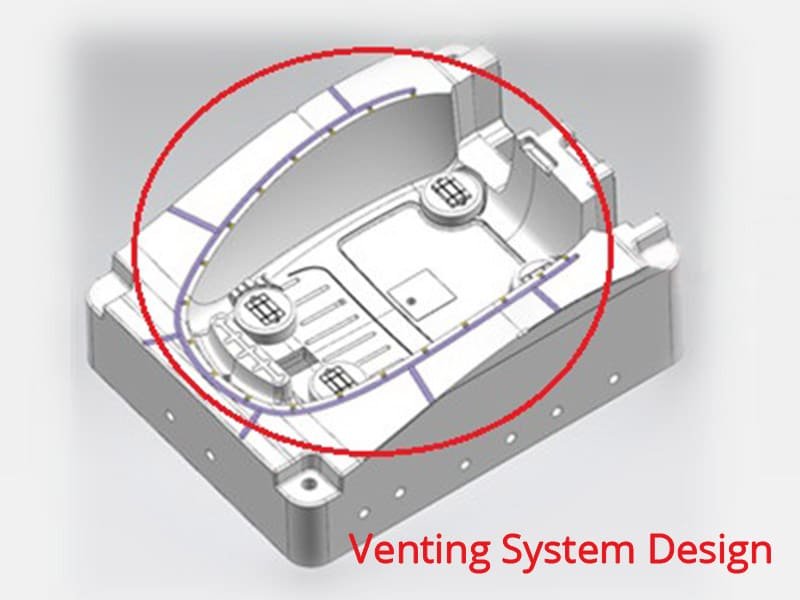
In precision mold design, the parting line, vent locations, and ejector layout all affect the mold’s ability to maintain specified tolerances. The parting line must be positioned to maintain accurate alignment between the mold halves and minimize flash on critical surfaces. Vents should be placed near the ends of the melt flow path to release trapped air. Inadequate venting may cause incomplete filling near critical features.
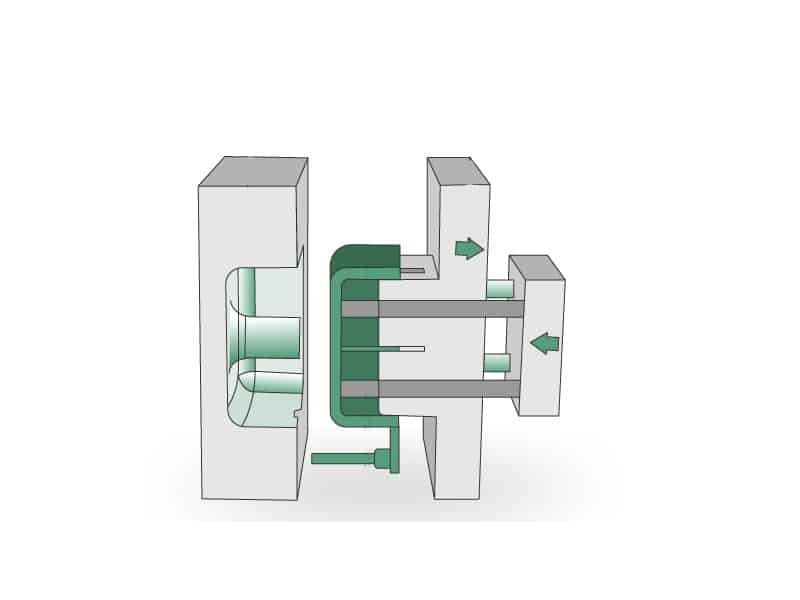
Ejector pins should contact areas with sufficient stiffness to prevent deformation, shifting hole positions, or altering flatness, especially around thin walls and precision features. Careful control of these features helps reduce dimensional variation and maintain precision mold tolerance across production cycles.
Tool Steel Selection for Precision Molds
Precision molds commonly use hardened tool steels or stainless mold steels to maintain dimensional accuracy, surface quality, and wear resistance over repeated molding cycles.
- S136 stainless mold steel: Used for precision molds producing transparent components or parts requiring highly polished surfaces and corrosion resistance.
- H13 tool steel: Used for precision molds producing parts exposed to demanding thermal cycling during repeated molding.
- P20 mold steel: A practical option for precision applications with low-wear requirements and less demanding surface finishes.
- High-hardness tool steel: Suitable for precision molds processing glass-filled or other abrasive resins, where cavity and core wear can affect dimensional accuracy.
For a closer look at common options and their properties, see this guide to injection molding tooling materials and tool steel types.
Key Characteristics of Precision Molds
The characteristics of precision molds extend beyond tight machining tolerances. They should withstand repeated molding cycles without significant wear or deformation.
High Wear Resistance
Precision molds have wear-resistant cavity, core, and gate surfaces that retain their geometry after repeated contact with flowing plastic. This property is particularly important when molding abrasive materials such as glass-filled plastics.
High Strength and Toughness
Precision molds combine sufficient strength to withstand injection pressure and clamping forces with toughness to resist cracking and impact damage. These properties help preserve mold integrity during repeated production cycles.
Excellent Fatigue Resistance
Precision molds withstand repeated mechanical loading and thermal cycling without developing premature fatigue cracks. Their resistance to cyclic stress reduces the risk of unexpected mold failure and unplanned production interruptions.
High-Temperature Stability
Precision molds retain their hardness, strength, and dimensional stability under repeated heating and cooling. This characteristic helps prevent premature wear and deformation when molding at elevated temperatures.
Quality Assurance in Precision Mold Production
Machining is only one stage in precision mold production. The mold must also undergo quality inspection to verify the mold’s accuracy and performance.
Dimensional and Geometric Inspection
Critical mold components are measured against engineering drawings using coordinate measuring machines (CMMs) and other precision instruments. Inspection focuses on cavity depth, core dimensions, hole locations, and geometric tolerances to verify that each component meets the specified machining requirements.

Mold Assembly and Fit Verification
After assembly, the mold is checked for smooth opening and closing, proper contact between parting surfaces, and reliable movement of guide pins and ejector components. These checks help ensure that the mold operates without interference or uneven contact that could affect molding consistency.
Trial Molding and Part Inspection
Trial molding verifies whether the precision mold can produce parts that meet specified dimensions under defined processing conditions. CMM measurements and dimensional reports help compare molded samples with the product drawing. If critical features fall outside tolerance, the mold or molding parameters may require adjustment before production approval.
Confirm Repeatability
Precision mold quality inspection should verify consistency across multiple molding cycles, not just one acceptable sample. Measuring parts from different shots and each cavity in a multi-cavity mold helps identify dimensional variation and confirm repeatability.
Future Trends for Precision Mold Manufacturing
Precision mold manufacturing is moving toward greater dimensional accuracy, shorter development cycles, and more consistent production quality.
Advanced Simulation and Digital Mold Design
Simulation tools are becoming more integrated into mold development. Mold-flow analysis, cooling, and deformation analysis can help predict potential defects and dimensional deviations before machining begins. As simulation accuracy improves, these tools can support more informed design decisions and reduce repeated mold modifications.
Smart Monitoring and Predictive Maintenance
Sensors and data-monitoring systems are increasingly being used to track mold temperature, pressure, and operating conditions during production. These data can help identify abnormal changes and signs of wear before they cause significant dimensional variation. Predictive maintenance may also reduce unexpected downtime and help extend mold service life.
Intelligent Manufacturing
Intelligent manufacturing is making precision mold production more data-driven and interconnected. Smart sensors, automated equipment, and cloud-based systems can coordinate machining operations, monitor equipment status, and track production data in real time. This integration helps identify manufacturing deviations earlier, reduce manual errors, and improve manufacturing efficiency and consistency.
Application of New Composite Materials
Advances in material science are expanding the options available for precision mold manufacturing. High-strength alloys and advanced composites offer different combinations of strength, low weight, corrosion resistance, and thermal stability. As new material formulations and processing methods develop, precision mold production may gain more options for balancing dimensional stability, durability, and manufacturing cost.
Conclusion
Precision is not defined by a mold’s dimensions alone, but by how reliably it reproduces the intended geometry over time. Every detail, from cavity design to material selection and quality inspection, contributes to that consistency. Erye provides injection mold services, including mold design and manufacturing, DFM analysis to identify potential issues before tooling begins, and dimensional inspection to verify critical mold features.