
Reaction Injection Molding (RIM), is a specialized manufacturing process tailored for producing plastic parts, particularly from thermosetting polymers. This comprehensive guide covers definitions, processes, materials, and comparisons, for RIM molding.
What is Reaction Injection Molding
Reaction Injection Molding, commonly abbreviated as RIM, is a manufacturing process where two or more liquid components are mixed and then injected into a mold. Inside the mold, these components undergo a chemical reaction, expanding and curing to form a solid part. This process is also known as Rim Molding, Rim Plastic Molding, or Reaction Injection Moulding (using British spelling). It is particularly suited for producing large, lightweight parts with quick cycle times.
RIM is noted for its versatility, capable of creating parts ranging from flexible to rigid and from solid to foamed structures. This flexibility is likely appealing to industries needing specific material properties, such as automotive for bumpers or medical for prosthetics.
RIM Molding Process
The RIM process can be broken down into several key steps. Here is the detailed step-to-step process.
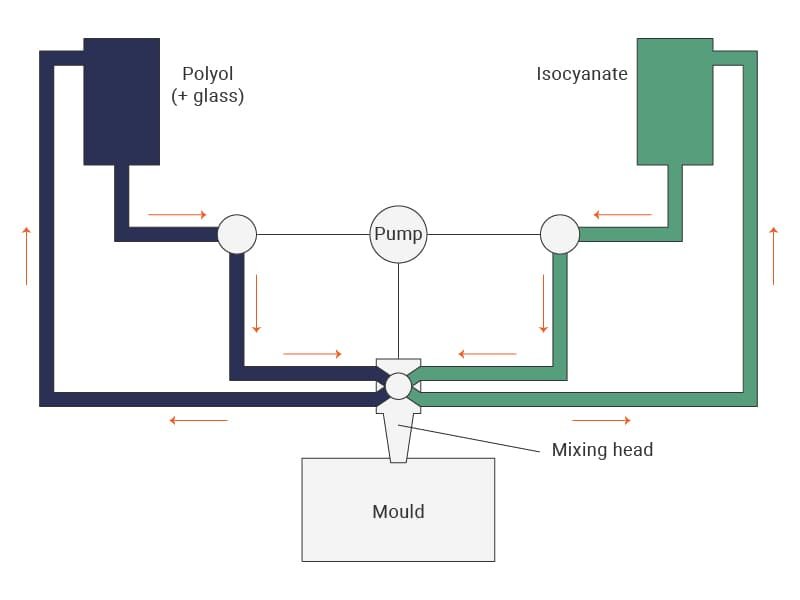
Storage of Components
Liquid components, such as polyol and isocyanate for polyurethane RIM, are stored separately in tanks.
Mixing
Components are pumped through high-pressure lines to a mix head, where they are thoroughly mixed at high velocity.
Injection
The mixture is injected into a closed mold at low pressure, allowing it to fill the cavity.
Curing
Inside the mold, the reactants react chemically, expanding to fill the mold and curing to form a solid part.
Demolding
After curing, the mold is opened, and the part is removed, with potential post-processing like trimming or painting.
RIM Process Variants: RRIM vs SRIM
In Standard Reaction Injection Molding (RIM), lightweight thermosetting plastic components are manufactured through reactions in mold and foaming. The industrial need for increased rigidity, strength, and impact resistance develop two advanced reinforced RIM variants: RRIM and SRIM.
RRIM (Reinforced Reaction Injection Molding)
The RRIM’s feature the use of short fibers for reinforcement. Glass fibers, carbon fibers, or mineral filler materials are supplied independently and thoroughly mixed with polyol and isocyanate resin under high pressure.
The RRIM technique toughens and stiffens part components without any increase in weight while providing mechanical improvement in a stable form. It is extensively applied in the manufacturing of automotive semi-structural parts including bumpers, body parts, and spoilers.

SRIM (Structural Reaction Injection Molding)
Key Differences Between RRIM and SRIM
The core differences are reinforcement methods and application positioning. RRIM adopts uniformly mixed short fibers to improve overall part toughness for cosmetic and semi-structural components, while SRIM forms a rigid framework with pre-placed fiber meshes for heavy-load structural parts.
In practical applications, RRIM provides cost-effective performance improvement for standard automotive exterior parts, while SRIM focuses on high-rigidity, safety-grade structural components. It requires superior deformation resistance and load-bearing performance.
Materials Used in Reaction Molding
The most common material in RIM is polyurethane (PU), which accounts for the vast majority of polyurethane molding formulas. Each system consists of a polyol and an isocyanate that react to form the polymer.
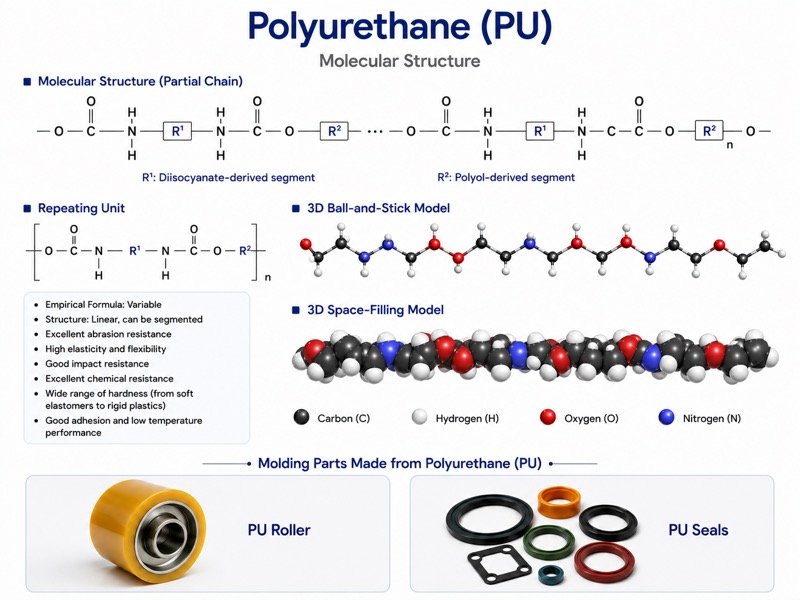
Other materials include:
- Polyureas
- Polyisocyanurates
- Polyesters
- Polyphenols
- Polyepoxides
- Nylon 6
Each material offers unique properties, and the choice depends on the part’s specific requirements. For instance, polyurethane RIM parts can be formulated for flexibility or rigidity, with varying densities and hardness levels. In the context of Reaction Injection Moulding, or RIM, the selection of material is crucial for achieving desired part properties.
Advantages of Reaction Injection Molding
RIM injection molding offers several advantages, making it a preferred choice for certain applications:
- Low Tooling Costs: RIM molds, often made from aluminum, are generally less expensive than the steel molds used in traditional injection molding, reducing initial investment.
- Fast Cycle Times: The chemical reaction forming the part is rapid, leading to quicker production cycles, which can enhance efficiency.
- Large Part Capability: RIM can produce very large parts, which might be challenging or impossible with other processes, due to the low viscosity of the mixture.
- Lightweight Parts: RIM parts can be designed to be lightweight, crucial for industries like automotive where weight reduction improves fuel efficiency.
- Complex Shapes: The process can handle complex geometries, suitable for parts with intricate designs, enhancing design flexibility.
- Good Surface Finish: RIM parts often have a good surface finish, reducing the need for additional finishing steps, which can save time and cost.
Disadvantages of Reaction Injection Molding
Materials for the RIM system are more expensive than normal thermoplastics. The injection molding machine for manufacturing is specific injection machine. It takes longer to manufacture parts using the RIM process than the regular injection method.
RIM has practical production and environmental flaws.The selection of thermoset materials is limited, small intricate designs cannot be reproduced. Low-strength aluminum molds are prone to damage, and ultra-large workpieces may face incomplete filling or uneven curing. Most RIM raw materials also release harmful VOC emissions during processing.
Reaction Injection Molding Applications
Automotive Industry
Electronics and Industrial Equipment
Reaction injection molding produces strong and impact-resistant as well as dimensionally stable housings for electrical appliances and machines.
Aerospace and Marine
The aerospace and marine industries use RIM to create light and corrosion resistant interior and exterior parts. Examples include aircraft panels, ducts, marine fenders, engine casings, ship seats and storage bins.
Medical and Consumer Goods
RIM is also used to make neat housing and comfort products for medical instruments. Consumer products manufacture using RIM includes furniture, household appliances, sporting equipment, helmets, and high-performance packaging foams.
Comparison with Traditional Injection Molding
Traditional injection molding, used for thermoplastics, involves melting the material, injecting it into a mold, and cooling it to form the part, which can be remelted and reformed. In contrast, RIM, uses thermosetting polymers that undergo a permanent chemical reaction, cannot be remelted, and operate at lower temperatures.
Key differences are summarized in the following table: