Injection mold lifespan determines how long a mold can maintain reliable performance under repeated production cycles. Its actual service life may differ from its intended cycle-life target as operating conditions and wear gradually affect mold performance. Understanding injection mold life expectancy helps explain why some molds remain reliable for years while others need attention much sooner.
How to Measure Injection Mold Lifespan
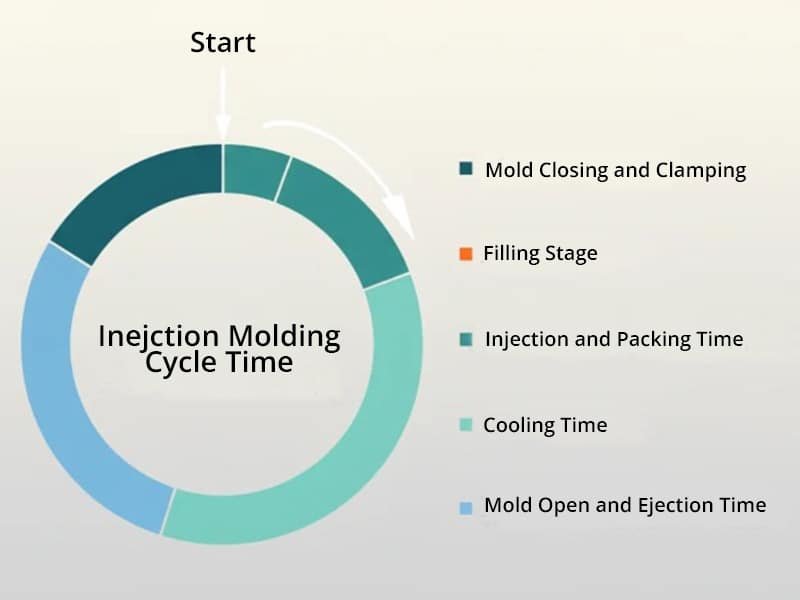
An injection mold lifespan describes how many molding cycles an injection mold can complete while producing parts that meet the required dimensions, appearance, and performance standards, and is not measured in months or years. One cycle covers a complete sequence in which the mold closes, plastic is injected, the part cools, the mold opens, and the part is ejected. A well-built mold may run for hundreds of cycles or more than one million cycles.
The injection molding cycle time helps estimate how many cycles the mold completes over a given period. If a mold runs a 30-second cycle for 8 hours per day, it can complete about 960 cycles per day. A mold reaches the end of its useful life when it can no longer make acceptable parts economically, even after reasonable maintenance or repair.
SPI Mold Classes and Expected Mold Lifespan
The Society of the Plastics Industry created clear mold standards. These classes define the injection mold lifespan for different molds. The following table outlines the typical cycle-life targets for each class.
| SPI mold class | Typical intended life | Typical use |
|---|---|---|
| Class 101 | 1,000,000 cycles or more | Very high-volume production |
| Class 102 | Up to 1,000,000 cycles | Medium-to-high volume production |
| Class 103 | Up to 500,000 cycles | General production at low-to-medium volumes |
| Class 104 | Up to 100,000 cycles | Low-volume production |
| Class 105 | Up to 500 cycles | Prototype and limited sample runs |
Aluminum vs. Steel Injection Mold Life
Mold material is a key factor in injection mold lifespan because it determines the tool’s resistance to wear, heat, and repeated molding pressure. Aluminum and steel are two common materials for injection molds, each offering different durability and performance.
| Comparison | Aluminum mold | Steel mold |
|---|---|---|
| Initial tooling cost | Often lower | Usually higher |
| Machining and design changes | Often faster and easier | Can take longer, especially with hardened steel |
| Wear resistance | Generally lower than hardened tool steel | Greater wear resistance |
| Thermal conductivity | Higher, faster heat transfer | Lower, slower heat transfer |
| Typical fit | Prototypes and lower-volume runs | Medium-and high-volume production |
| Maintenance | Can be repaired, but damaged surfaces may limit recovery | Many grades allow repair, polishing, insert replacement, or welding when appropriate |
What Factors Affect Injection Mold Lifespan
Injection mold lifespan is closely related to the rate of mold wear. As wear accumulates on cavity surfaces and moving components, the mold may lose dimensional accuracy, produce defective parts, or require repairs, all of which affect its usable service life.
Mold Construction
The structural design of an injection mold affects its lifespan by determining how mechanical loads are distributed across its components during repeated production cycles. Slides, lifters, and ejector systems are particularly sensitive to alignment and load distribution. Poor alignment or uneven loading can cause localized stress, accelerate mold wear, and lead to premature failure.
Plastic Resin and Additives
The type of plastic resin directly affects injection mold lifespan. Glass fibers, mineral fillers, and other abrasive additives can wear on cavity surfaces, gates, runners, and moving components, which can shorten the mold’s service life. For example, glass-filled nylon causes more abrasive wear than unfilled nylon. Corrosive resins can also damage mold surfaces when the steel grade or protective treatment is unsuitable.

Part Geometry and Mold Complexity
Complex part features can increase friction, ejection resistance, and mechanical stress during production. Undercuts and side actions require repeated movement of slides and lifters, while deep ribs and small cores may experience greater stress during part ejection. These conditions can cause premature wear and reduce the number of cycles a mold completes before repair.
Processing Conditions
Processing parameters influence the thermal and mechanical loads that accumulate during production. Excessive injection pressure accelerates cavity wear, while fluctuating mold temperatures cause repeated expansion and contraction that can lead to heat checking or micro-cracks. Excessive clamping force can also damage the parting line through repeated loading. Over time, these conditions will accelerate mold deterioration.
Mold Surface Condition and Lubrication
Mold surface condition and lubrication affect injection mold lifespan through wear and corrosion. Plastic residue can scratch cavity surfaces, inadequate lubrication increases friction between moving components, and moisture on mold surfaces or inside cooling channels can cause corrosion. These issues can shorten mold lifespan by compromising surface finish and dimensional accuracy.