
CNC prototype machining produces parts with tight tolerances and the same mechanical properties as the final product. That makes them reliable for checking fit, function, and appearance before a design is finalized. When you need accurate samples in real materials within days, you can choose CNC machined prototypes. This guide covers what CNC prototype machining is, how it compares with 3D printing, and where it works best.
What Is CNC Prototype Machining?
CNC prototype machining produces early-stage parts from metal or plastic stock using computer-controlled equipment to cut material to a digital design. This CNC machining process is different from the production stage. A production run focuses on efficiency and consistent output, while a prototype run aims for speed, accuracy, and useful feedback, so quantities stay small, usually between one and fifty pieces.
Unlike other prototyping methods, CNC-machined prototypes are cut from solid stock, so they carry the same mechanical properties as the final product. This allows you to evaluate how the part will perform in actual use, not just how it looks or fits.
CNC Prototype Machining vs 3D Printing
Both methods produce prototypes quickly, but they use different manufacturing processes and offer different characteristics. That basic difference affects their surface finish, material options, and suitability for different prototype requirements.
| Factor | CNC Prototype Machining | 3D Printing |
|---|---|---|
| Process type | Subtractive | Additive |
| Surface finish | Smooth machined surface | Visible layer lines on most processes |
| Material range | Production-grade metals and plastics | Limited to printable resins, powders, and filaments |
| Part strength | Uniform, no layer weakness | Can vary with print direction |
| Complex internal geometry | Limited by tool access | Can produce complex internal features |
| Best for | Functional testing, tight fits, final-look samples | Concept models, complex shapes, very early drafts |
The two methods can also be used at different stages of the same prototype development process. 3D printing can print a rough concept in the first week. Once the shape settles, CNC prototype machining is used for functional tests. This sequence keeps early costs low and later data accurate.

Key Steps in the CNC Prototype Machining Process
Two early choices will have a significant impact on the early results of CNC prototyping: the material and the machining method. The material influences the features of the parts. The machining method decides which shapes the part can take and how accurately it can be cut.
Material Selection
Material selection should reflect the type of performance the prototype needs to evaluate. For load or structural testing, the prototype should use the same material as the final part. For fit or appearance checks, a lower-cost material that is faster to machine may be sufficient. The four materials below are common choices for CNC prototypes.
- Aluminum: Light, easy to cut, and corrosion-resistant. Suits housings, brackets, and load-bearing parts.
- Stainless steel: Corrosion-resistant and durable. Suits food-contact parts, fittings, medical parts, and marine hardware.
- ABS: Tough, impact resistant, and easy to finish. Suits visual prototypes, enclosures, and handheld devices
- Nylon: Wear-resistant and flexible. Suits wear pads, hinges, and light-duty gears.
Machining Process Selection
The part geometry decides which machining method fits best. Choosing the right process affects how efficiently and which features the part can be machined, and how accurately the final prototype can be produced. Three options cover most prototypes:
- CNC milling suits flat, boxy parts with pockets, slots, and holes, such as housings and brackets.
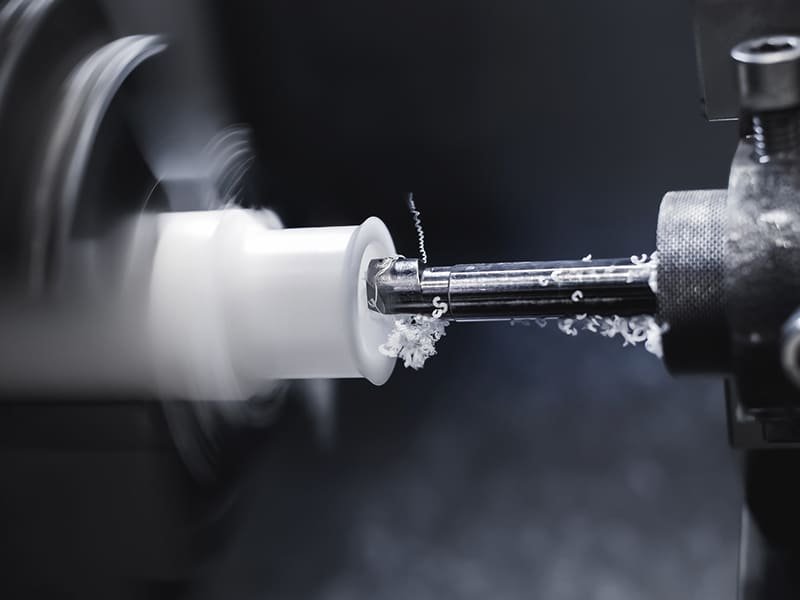
- CNC turning suits round parts, such as shafts, pins, and bushings.
- Multi-axis machining suits parts with angled or curved features, such as impellers and complex housings.
Advantages of CNC Prototype Machining
CNC prototype machining offers several advantages when moving from a design to a tested part. It delivers parts quickly, keeps results consistent, and holds up well under real testing conditions.
Fast Turnaround
CNC machines cut parts directly from a digital file. This removes most of the preparation time that other methods need. Simple prototypes often finish within one to five days, so testing and design revisions can happen in quick cycles.
Repeatability and Consistency
Once the CNC program is established, the same toolpaths can be repeated with consistent dimensions from one prototype to the next. This makes it easier to compare different design revisions and see how each change affects the part’s performance.
Structural Integrity for Functional Testing
Because CNC prototypes are machined from solid material, they do not have the layer-to-layer weakness associated with many 3D printing processes. Their strength, stiffness, and other material-dependent properties can provide a more representative basis for functional and structural testing.
From Prototype to Production
CNC prototype machining can provide a practical bridge between design validation and production. Most of the key production requirements have already been established and validated, it can be directly adapted for low-volume production.
Limitations of CNC Prototyping Processes
While CNC prototyping offers precision and reliable results, it also has some limitations compared with other prototyping methods, particularly in terms of geometry, material use, and cost.
Geometry Constraints
CNC cutting tools need access to every surface, which limits the shapes a machine can produce. Other prototyping methods such as 3D printing build up material layer by layer, so they can reach internal cavities and channels that a cutting tool cannot enter.
Material Waste
CNC machining removes material from solid stock, so part of the original block ends up as scrap. Chips can be recycled, but the stock material still adds to the machining cost. Other prototyping methods such as 3D printing add only the material a part needs, which produces far less waste on complex or hollowed-out shapes.
Higher Cost
CNC prototyping can cost more than some other prototyping methods, especially when only a few simple parts are needed. More material usage, machining, setup, and post-processing costs can all add to the total.
Applications of CNC Machined Prototypes
From aerospace and automotive components to medical devices, electronics, and industrial equipment, machined prototypes can be used to evaluate different types of parts before production.
Aerospace
Brackets, housings, and fittings can be prototyped in lightweight alloys to verify fit, strength, and assembly. A titanium bracket, for example, can be machined to check its fit against a mounting plate before flight-grade production.
Automotive
Engine parts, sensor housings, and interior components can be prototyped for functional testing. A turbo actuator arm, for example, can undergo dyno testing to evaluate strength and wear before production.
Medical Devices
Surgical tools, device enclosures, and implant components require precise geometry and reliable fit. An ultrasound probe housing can be machined in ABS-like plastic to evaluate ergonomics before switching to a high-cost biocompatible material.
Consumer Electronics
Aluminum enclosures, heat sinks, and button assemblies can be prototyped to verify dimensions, fit, and thermal performance. A smartwatch case, for example, can be tested for proper alignment with the display and battery before the design is finalized.
Robotics and Automation
Gears, joints, and end effectors can be prototyped to evaluate fit, movement, and load performance. A gripper finger, for example, can be machined in nylon and tested with real packages.
Industrial Equipment
Manifolds, pump components, and valve bodies often require tight fits and reliable sealing. An aluminum hydraulic manifold can be prototyped to check connections and leak paths at operating pressure.
Start Your CNC Prototyping Project With Erye
CNC prototyping gives you a functional, accurately machined part for checking fit, performance, and design details before production. Erye’s CNC machining services cover milling, turning, and multi-axis machining for a wide range of metals and plastics, supporting your project from prototype development through production. Upload your 3D file and drawing to receive a quote with practical DFM feedback for your part.