
Cooling is a crucial stage within the injection molding cycle and often requires a significant portion of the overall production time. A proper understanding of cooling principles helps ensure that molded parts achieve the required performance while supporting efficient production planning.
Why Cooling Time Matters for Injection Molding
Cooling time is a key component of the injection molding cycle time that refers to the period required for molten plastic inside the mold cavity to cool down and solidify before the mold can be opened and the finished part can be removed. During cooling, heat is transferred from the plastic part to the mold through conduction, allowing the material to solidify and maintain its final shape. Proper control of this stage ensures that the part reaches the required hardness and dimensional stability before ejection.
Reduces Injection Molding Cycle Time
Cooling time directly affects the total injection molding cycle because it is often the longest stage of the process. Excessive cooling increases cycle time and production expenses. Optimizing cooling duration allows manufacturers to produce more parts within a shorter period while maintaining consistent quality and improving overall production efficiency.
Prevents Surface Defects
A well-controlled cooling process helps maintain consistent surface appearance and mechanical properties. Poor cooling conditions may lead to some injection molding defects including sink marks, deformation, uneven gloss, and other appearance-related problems that reduce part quality.
Improves Mold Performance and Process Consistency
Proper cooling time can ensure uniform heat removal throughout the molding cycle, improving mold performance and maintaining process consistency. This leads to more stable production results, improved repeatability between cycles, and reduced stress on the mold over long-term operation.
Cooling Time Calculation in Injection Molding
Cooling time estimation in injection molding can be performed using a mathematical formula that considers the part thickness and the material’s thermal diffusivity. This thermal diffusivity describes how quickly heat moves through a plastic material and is determined by the relationship between thermal conductivity, density, and specific heat capacity. The value can be calculated by dividing the material’s thermal conductivity by the product of its density and specific heat capacity.
The simplified injection molding cooling time equation is:
t_c = (π² / (4αs²)) × ln[(8(T_m – T_mold)) / (π²(T_e – T_mold))]
Where:
- t₍c₎ = cooling time
- s = maximum part thickness
- α = thermal diffusivity of the plastic material
- Tₘ = melt temperature
- Tₘold = mold temperature
- Tₑ = ejection temperature
In practical injection molding production, cooling performance is also affected by processing conditions. Manufacturers often combine calculations with simulation results and production testing to achieve accurate cycle times. Our experienced engineers can help evaluate cooling requirements and develop an efficient molding solution for your application.
Factors Affecting Cooling Time and How to Optimize
Cooling time in injection molding is influenced by several factors, including material selection, mold design, and cooling system performance.
Plastic Material Properties
Materials with different thermal conductivity, processing temperatures, and heat transfer properties require different cooling times. For example, ABS generally cools faster due to its moderate processing temperature, while PC typically requires longer cooling because it is processed at a higher temperature.
When selecting a material for an injection molded part, consider not only mechanical performance but also how its thermal properties may affect cooling time.
Mold Geometry
The size and geometry of the mold influence how efficiently heat is removed from the molded part. Larger parts or complex geometries usually require longer cooling times because they contain more material and have longer heat transfer paths.
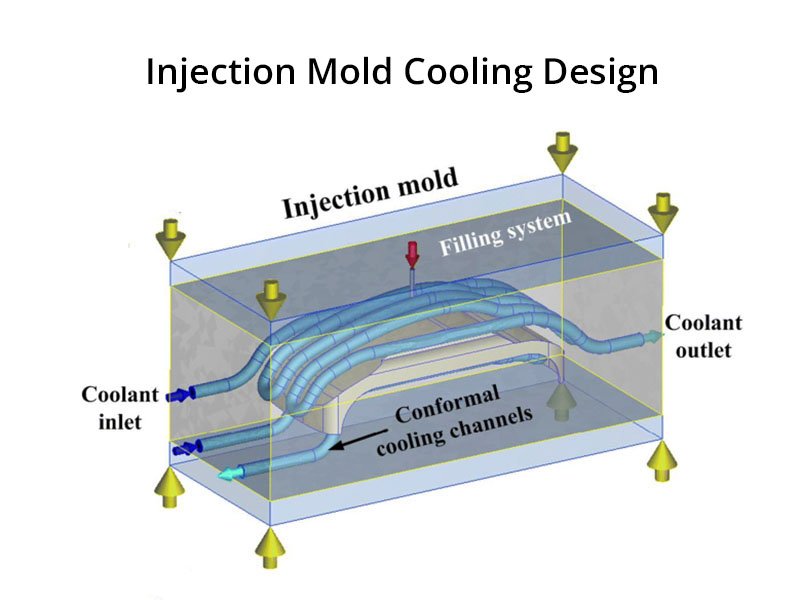
During the design stage, features such as uniform wall thickness, appropriate gate location, and balanced cooling channels design can help improve cooling efficiency and reduce potential issues such as warpage or dimensional variation.
Mold Temperature
Mold temperature has a direct impact on both cooling time and final part performance. A lower mold temperature can shorten cooling time but may increase internal stress or affect surface appearance. A higher mold temperature can improve surface finish and reduce stress but may extend the cooling cycle.
The ideal mold temperature depends on the selected plastic material, part requirements, and desired surface quality.

Cooling System and Process Monitoring
An effective cooling system helps maintain stable molding conditions throughout production. Factors such as coolant temperature, water flow rate, and cooling channel condition can influence overall cooling performance.
For projects requiring tight tolerances or high-volume production, simulation analysis and process monitoring can help identify the appropriate cooling parameters and improve production consistency.
How Insufficient Cooling Time Affects Part Quality
Insufficient cooling time can lead to several quality issues in injection molded parts, including:
- Warpage and Deformation: Ejecting a part before it has fully developed enough strength may allow internal stresses to cause plastic warpage or shape distortion.
- Sink Marks: Inadequate cooling can prevent thicker areas from solidifying completely, resulting in sink marks on the surface of the part.
- Dimensional Instability: Parts may continue to shrink after ejection, causing dimensional changes that affect accuracy and assembly performance.
- Ejection Problems: Parts that are not sufficiently cooled may stick to the mold surface or become damaged during the ejection process.
- Internal Stress: Uneven or rapid cooling can create residual stress inside the part, potentially reducing its mechanical strength and long-term durability.
Conclusion
Cooling time is a critical factor in injection molding that affects part quality, production efficiency, and manufacturing cost. Although shorter cooling times can improve productivity, they must be carefully balanced with material characteristics, mold design, and product requirements.
Experienced injection molding manufacturers like Erye use optimized tooling designs and injection molding services to improve cooling efficiency and deliver reliable molded parts for various industries.