
Injection molding tolerances refer to the allowable variation between a part’s intended dimensions and its actual molded outcome. Unlike machined components, plastic injection parts are affected by material shrinkage, cooling behavior, and process variability, making absolute precision impractical.
In injection molding, we need to consider two different tolerances: machining tolerance and resin tolerance. The machining tolerance is the tolerance of the mold tool. The resin tolerance is the finished molded part tolerance.
From a product standpoint, tolerances directly influence part fit, assembly performance, and overall quality. However, tighter tolerances are not always better—they often increase tooling complexity, production cost, and lead time. In practice, tolerance is not just a specification, but the result of how design, material, tooling, and process interact.
The following sections outline the key factors that influence injection molding tolerances and how each can be controlled.
DFM Product Design Considerations
Design for Manufacturability (DFM) plays a decisive role in achieving the required injection molding tolerances. Even with advanced tooling and precise process control, poor design choices can introduce dimensional variation that makes tight tolerances unachievable.
Maintain Uniform Wall Thickness
Wall thickness consistency is one of the most critical factors affecting tolerance. Parts with thick and thin sections experience uneven cooling. Thicker areas retain heat longer, resulting in higher shrinkage, while thinner sections solidify faster. This differential shrinkage often causes warpage or internal stress, directly impacting dimensional accuracy and making it difficult to meet specified tolerances.
To control tolerance through wall thickness design. Limit wall thickness variation to no more than 15% of the nominal wall thickness. For example, for a 2.5 mm nominal wall, keep all walls between 2.125 mm and 2.875 mm. Add generous radii at transitions between thick and thin areas—at least 0.5 times the wall thickness. Maintaining uniform thickness reduces shrinkage variation, helping parts consistently stay within the desired tolerance range.
Proper Part Geometry Features
Draft angles significantly influence the ability to meet tight tolerances. Vertical walls without draft require higher ejection forces, which can distort critical features. Apply a minimum draft of 1 to 2 degrees on all vertical surfaces. For textured surfaces, increase the draft to 3 degrees or more.
Ribs and bosses also impact tolerance. Thick bosses isolated from side walls create localized thick sections. Connect bosses to adjacent walls with ribs that maintain uniform wall thickness. Place ribs no thicker than 60 percent of the adjacent wall and space them at least twice the wall thickness apart to prevent flow hesitation. These design practices help control shrinkage and maintain dimensional stability, keeping parts within specified tolerances.
Material Shrinkage Behavior
Material selection directly affects injection molding tolerances, as different plastics shrink differently during cooling. Amorphous resins such as ABS and polycarbonate typically shrink between 0.4% and 0.9%. Semi-crystalline resins such as polypropylene and nylon can shrink between 1.0% and 2.5%. Glass-filled materials show different shrinkage rates along the flow direction versus across it. Batch-to-batch variation in filler content can also shift the shrinkage.
To maintain dimensional accuracy,
- Choose materials with predictable shrinkage behavior compatible with tight tolerances.
- Validate shrinkage through prototype mold trials.
- Account for anisotropic shrinkage in fiber-filled plastics when designing critical features.
Understanding material behavior ensures that shrinkage does not push features outside the specified tolerance range.
How to Control Material Shrinkage and Optimize Tolerance
- Select the exact material grade planned for production and record its published shrinkage value from the technical data sheet.
- Scale all mold cavity dimensions upward by the expected shrinkage percentage.
- For tolerances tighter than ±0.10 mm, run a mold filling simulation to identify anisotropic shrinkage and adjust gate location accordingly.
- After mold completion, perform a short-shot study on the actual machine. Adjust pack pressure and hold time until actual shrinkage matches the predicted value within 0.05%.
- If the material changes, recalculate mold scaling and verify with new sample parts.
- Choose low-shrinkage grades when tolerances below ±0.05 mm are required. Always confirm production material lots match the data sheet used for design.
Typical Shrinkage Ranges for Common Plastics
| Material | Shrinkage Range (%) |
|---|---|
| ABS | 0.4 – 0.7 |
| Polycarbonate (PC) | 0.5 – 0.7 |
| Polypropylene (PP) | 1.0 – 2.5 |
| Polyethylene (PE) | 1.5 – 3.0 |
| Polystyrene (PS) | 0.4 – 0.7 |
| Nylon (PA6 / PA66) | 1.0 – 2.0 |
| Acetal (POM) | 1.5 – 2.2 |
| PET | 0.2 – 0.6 |
| PMMA (Acrylic) | 0.2 – 0.8 |
| Glass-Filled Nylon | 0.2 – 1.0 (varies by fiber content) |
Mold Design and Tooling Factors
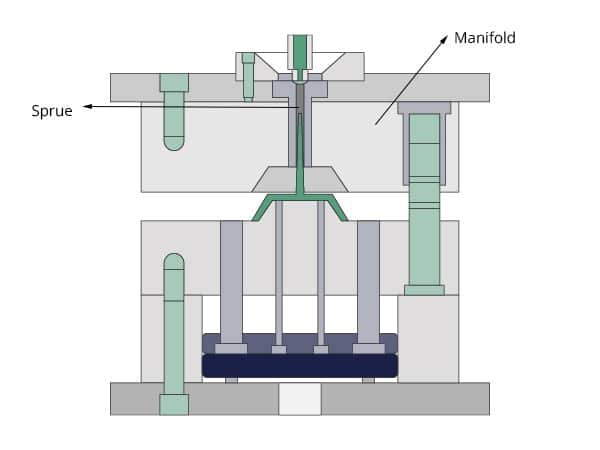
The mold sets the baseline for achievable injection molding tolerances, but this accuracy can change over time. Any variation at the tooling level will directly affect part dimensions。
CNC-machined mold cavities typically start with an accuracy of around ±0.127 mm. However, repeated production cycles cause wear on parting lines, ejector pins, and sliding components. This wear increases internal clearances, leading to flash or gradual dimensional drift that can push parts out of tolerance.
Mold alignment is another key factor. If the core and cavity are not perfectly aligned during setup, even a small misalignment between the core and cavity, usually around 0.02–0.05 mm, can introduce noticeable dimensional variation, especially for tight-tolerance parts.
Cooling system design further affects dimensional accuracy. Uneven cooling creates differential shrinkage, which can result in warpage or localized dimensional changes. This makes it harder to maintain consistent injection molding tolerance.
How to Optimize Mold Design and Control Tolerances?
Confirm the expected production volume and ensure the mold is built with suitable materials. For moderate volumes, standard tool steels are usually sufficient. For higher volumes, more durable tool steels are needed to reduce wear and maintain stable dimensions over time. It is also important to request inspection reports, such as CMM data, before the first trial to verify that the mold meets the required accuracy.
A well-designed mold with a uniform cooling system helps reduce shrinkage variation and improve dimensional consistency, which is essential for holding tight tolerances. Well-designed cooling channels should ensure cavity surface stays within ±2 °C during the cycle.
Regular mold maintenance is necessary to prevent dimensional drift. Make a maintenance plan to check wear-prone areas such as parting lines and ejector components during production.
Ensuring that the mold is correctly aligned during installation. Use tight-fitting locating rings and dowel pins for repeatable core-cavity alignment. Ensuring the injection machine provides sufficient and stable clamping force.
Manufacturing Process Factors
Even with optimized design, material, and tooling, injection molding tolerances ultimately depend on process stability and repeatability.
The most important thing is establishing a repeatable molding process. Injection molding involves filling, packing, and cooling, and each stage must remain consistent from cycle to cycle. A stable, well-defined process ensures parts remain consistent across both short runs and long production cycles.
Controlling key process parameters is essential. Variables such as injection pressure, holding time, and temperature directly influence shrinkage behavior. Instead of focusing on exact values, the priority is to maintain these parameters within a stable range.
Process monitoring will improve consistency. Manufacturers with real-time monitoring systems can quickly detect deviations and make adjustments before parts fall out of tolerance. This is especially important for tight-tolerance applications.
Measurement is also a factor to be considered. To ensure accurate measurement of injection molded parts, it is important to know when, how, and under what conditions the measurement is performed. Plastic parts are sensitive to temperature. Plastic parts continue to shrink and relieve internal stress after ejection. For this reason, Erye Molding measures the dimensions again after the parts have cooled and stabilized for at least 24 hours. This prevents misinterpretation of tolerances caused by shrinkage.
In practice, controlling injection molding tolerances at the production stage comes down to one principle: a stable, controlled, and repeatable process leads to consistent part dimensions.
FAQ for Injection Molding Tolerance
Which injection molding tolerances do you need to specify?
Commercial tolerances (±0.15 mm) are less precise but more economical to produce. Fine tolerances (±0.05 mm or tighter) offer higher precision but raise tooling and processing costs.
There are several types of tolerances you may need to specify, depending on your part’s requirements:
- Dimensional tolerances (length, width, diameter, etc.)
- Straightness/flatness
- Hole diameter
- Blind hole depth
- Concentricity/ovality
On the drawing, clearly mark the critical features, state the required tolerance for each one, and indicate whether commercial or fine tolerance applies. Add a short note.
What Are Typical Plastic Molding Tolerances?
Typical injection molding tolerances are not universal fixed values. They are usually defined based on industry standards and manufacturer capability, with variation depending on part size, material, and feature type. Most references in the industry are based on ISO 20457 and DIN 16742, which provide general tolerance frameworks for molded plastic parts.
Standard or “commercial” injection molding tolerances are typically in the range of ±0.1 mm to ±0.3 mm. This range is widely referenced in industry tolerance guides based on DIN 16742 (standard tolerance grades for molded parts) and commonly used for non-critical features like housings and covers.
Fine tolerances are generally in the range of ±0.05 mm to ±0.1 mm. This level is typically associated with precision grades in DIN 16742 tolerance classes and is commonly applied to functional features such as snap fits, mating parts, and alignment features.
For high-precision applications, tight tolerances can reach approximately ±0.01 mm to ±0.05 mm, but only for selected critical features. This range is not a full-part standard but a capability-based limit often referenced in medical, optical, and precision engineering applications.
It is important to note that all tolerance values are influenced by part geometry, material shrinkage, and feature type. Larger parts typically require wider tolerances due to accumulated shrinkage variation.
How to Choose a Supplier That Can Hold Tight Tolerances?
Selecting the right supplier is critical when tight tolerances are required. Capability is not determined by equipment alone, but by the integration of design support, tooling expertise, and process control.
A qualified supplier should be able to provide:
- DFM analysis to optimize part design before production
- High-precision tooling capabilities with proven experience
- Established process control systems, including SPC and validation protocols
- Advanced inspection equipment, such as CMM for dimensional verification
- Demonstrated experience with similar materials and applications
Conclusion
Injection molding tolerances are the result of a complex interaction between design, material, tooling, and process. Achieving consistent dimensional accuracy requires more than specifying numbers on a drawing—it demands a systematic approach to controlling variation at every stage. Erye provides professional injection molding services and effective tolerance control based on rich experience. Welcome to contact us and get a custom solution.