
Screw threads are one of the most widely used mechanical features in CNC machining and manufacturing. They allow components to be assembled, fastened, adjusted, or connected with precision. With various thread standards, profiles, and specifications available, selecting the correct thread type is important for achieving proper fit, compatibility, and reliable assembly performance. This guide explains the core elements of screw threads, common thread standards, and different thread profiles.
What Is a Thread?
A thread is a spiral-shaped feature formed along the surface of a cylindrical or conical part. When two threaded parts are joined, the spiral surfaces engage with each other, creating a secure connection that can withstand applied forces while allowing parts to be assembled or removed when needed.
You can find threaded features in many everyday and industrial products, from bottle caps and fasteners to mechanical components and piping systems. Since threads are used in a wide range of applications, they are manufactured in different forms to meet specific requirements.
Choosing the wrong thread profile isn’t just an academic mistake, it can lead to failed assemblies, scrapped parts, or costly rework after machining. Whether you’re designing a fastener or a linear motion system, understanding the terminology below will help you communicate requirements clearly and avoid unforeseen circumstances.
Core Elements of Screw Thread
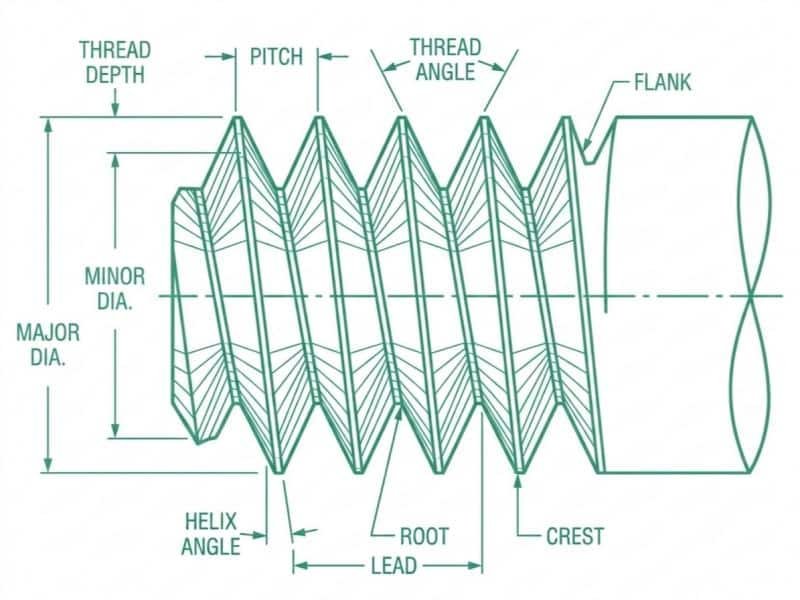
Understanding the basic terminology of screw threads makes it easier to identify thread specifications and choose the right thread type for different applications.
Pitch
Pitch refers to the distance between two adjacent thread crests, measured parallel to the thread axis. It determines how far a threaded component moves with each rotation. A smaller pitch creates finer threads with more thread engagement per length, while a larger pitch creates coarser threads that allow faster assembly with fewer turns.
For metric threads, pitch is usually expressed in millimeters (mm). For example, an M8 × 1.25 thread has a pitch of 1.25 mm.
An incorrect or missing pitch callout is one of the most common causes of rework on quoted drawings — always double-check this value before submitting a part for machining.
Pitch Diameter
In addition to pitch, pitch diameter is another important measurement used to define thread fit. Pitch diameter is the theoretical diameter where the thickness of the thread ridge equals the width of the thread groove. It is one of the most important measurements for determining thread fit and tolerance.
Root
The root is the lowest point between two adjacent thread profiles. It connects the two sides of the thread and forms the base of the thread groove. A sharp root can create stress concentration points that may reduce fatigue resistance, while a rounded root helps distribute stress more evenly and improves resistance to repeated tightening and loosening.
Flank
The flank is the angled surface connecting the crest and root of a thread. It forms the main contact area between mating threads and is responsible for transferring most of the load during tightening, fastening, or motion transmission. The angle of the flank, known as the thread angle, is an important feature used to define different thread standards and affects thread engagement, friction, and overall fit between components.
Crest
The crest is the highest point of a thread profile. For external threads, it is the raised outer edge of the thread. For internal threads, it is the highest point inside the threaded hole.
Lead
Lead is the axial distance a threaded component travels during one complete rotation. For single-start threads, the lead equals the pitch. For multi-start threads, the lead is calculated by multiplying the pitch by the number of thread starts.
A smaller lead generally provides greater mechanical advantage and finer movement control, while a larger lead enables faster movement with fewer rotations.
Major Diameter
The major diameter is the largest diameter of a screw thread. For external threads, it is measured across the thread crest. For internal threads, it refers to the largest theoretical diameter of the threaded hole. Major diameter is typically used as the primary size designation in thread specifications, such as M8 or 3/8″-16.
Minor Diameter
The minor diameter is the smallest diameter of a thread. It represents the diameter at the root of an external thread or the crest diameter of an internal thread. Minor diameter influences thread strength and material removal during machining.
What Are the 3 Basic Standards of Threads?
The three major thread classification systems used in machining are:
- ISO Metric Thread Standard
- American Thread Standards
- British Whitworth Threads
Each standard defines thread dimensions, angles, tolerances, and applications. If your parts will be sourced or assembled internationally, matching the right standard to your supply chain matters just as much as getting the geometry right.
ISO Metric Thread Standard
ISO Metric threads are primarily used in Europe, especially in mechanical and industrial applications. Metric threads use millimeters as the measurement system and are identified by the letter M followed by the nominal diameter and pitch.
Example:
M10 × 1.5
Where:
- M = Metric thread
- 10 = Major diameter
- 1.5 = Pitch
Metric threads are available in both coarse and fine pitch series. Coarse metric threads are commonly used for general fastening applications because they provide easier assembly and good resistance to damage during installation.
Fine metric threads, also known as ISO Metric Fine Threads (MF), have a smaller pitch compared with standard metric threads. They provide better adjustment accuracy, increased thread engagement, and improved resistance to loosening in applications where precise positioning or stronger clamping control is required.
American Thread Types
American thread standards are widely used in the United States and North American manufacturing industries. It uses inch-based measurements and a 60° flank angle.
| Thread Category | Thread Type | Characteristics | Applications |
|---|---|---|---|
| Unified Threads (UTS) | UNC | Few threads per inch, Coarse pitch, easy assembly, durable | General fasteners, machinery |
| UNF | More threads per inch, Larger minor diameter, Fine pitch, precise adjustment, vibration resistance | Automotive, aerospace | |
| UN | Constant pitch series | Specialized fasteners | |
| UNEF | Extra fine pitch, high precision | Precision components | |
| Pipe Threads | NPT | Tapered thread, self-sealing | Fluid and gas connections |
| NPS | Straight thread, requires sealing | Pipe fittings | |
| NPTF | Tapered thread, improved sealing | Hydraulic and fuel systems |
British Whitworth Threads
British Whitworth threads are older thread standards developed in the UK. Although less common today, they are still used in certain industries and legacy equipment. It has a 55° thread angle.
| Thread Type | Characteristics | Applications |
|---|---|---|
| BSW | Coarse pitch | Historical machinery, industrial equipment |
| BSF | Fine pitch, improved precision compared with BSW | Precision mechanical components |
| BSP / BSPT | Tapered pipe thread, used for sealing connections | Fluid systems, Pipe applications |
If you’re maintaining or replacing parts for older or imported equipment, confirming whether it uses Whitworth threading before ordering replacements can save you an awkward fitment issue down the line.
What Are the Different Thread Types?
Besides thread standards, threads can also be classified by location, direction, number of starts, and profile shape. Each of these choices affects how your part performs and how easily it can be manufactured, so it’s worth thinking through them early.
Based on Location
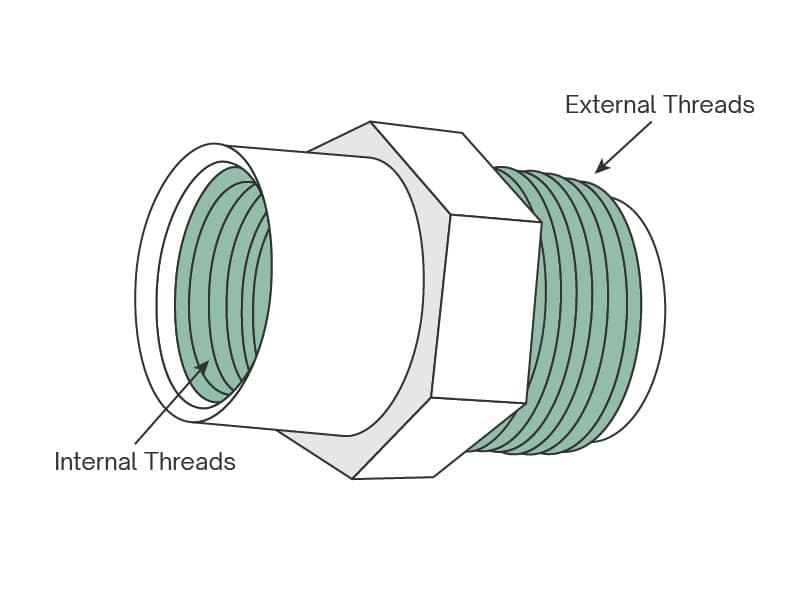
External Thread
An external (male) thread is a thread formed on the outside surface of a component. It is designed to engage with an internal thread, such as a nut or a tapped hole, to create a secure mechanical connection. External threads are usually measured using major diameter and pitch. Common examples include bolts, screws, studs, and threaded shafts.
Internal Thread
An internal (female) thread is a helical groove machined or formed on the inside surface of a hole. It is designed to mate with an external thread, such as a bolt or screw, to create a secure and removable connection. Common examples include nuts, tapped holes, housings, and components with threaded inserts.
Based on Direction
Right-Hand Thread
Right-hand threads are the most common thread type. They tighten when rotated clockwise and loosen when rotated counterclockwise, which aligns with common hand movement and makes them the default option for most components.
Left-Hand Thread
Left-hand threads use the opposite rotation direction, tightening counterclockwise and loosening clockwise. They are mainly used in applications where vibration, rotation, or operating forces may cause a conventional right-hand thread to gradually loosen. Common examples include bicycle pedals, where the reverse thread direction helps prevent unintended disassembly during operation.

Based on Number of Starts
Single-Start Thread
Single-start threads consist of a single helical ridge that wraps around the shaft. During one complete rotation, the thread advances a distance equal to one pitch, providing consistent movement and reliable engagement. Due to their simple structure and controlled tightening behavior, they are widely used in common fastening applications.
Multi-Start Thread
Multi-start threads contain multiple parallel thread ridges. This configuration increases the lead, allowing the threaded component to move a greater distance with each rotation while maintaining the same pitch. They are typically selected for applications that require faster linear movement and higher operating efficiency, such as lead screws, actuators, and motion control.

Based on Profile Shape
“V” Shape Threads
V-shaped threads are the most widely used thread profile for general fastening applications. V-shaped threads typically have a 60° included angle between the two thread flanks, creating the characteristic V-shaped profile. This geometry provides reliable engagement between mating threads and is widely adopted because of its standardized design and ease of manufacturing. To improve durability, the sharp edges of the original V profile are usually modified with flattened crests and rounded roots to reduce stress concentration and minimize the risk of thread damage.

Square Threads
Square threads have a square-shaped profile with flat sides and are primarily designed for power transmission. Their geometry allows force to be transferred efficiently along the direction of motion, resulting in low friction and smooth linear movement. However, square threads are more difficult and costly to manufacture compared with other thread profiles, and their standardization is limited.

Acme Threads
Acme threads have a trapezoidal profile with a 29° thread angle. Compared with square threads, the angled flanks make Acme threads easier to machine and more robust under load while maintaining efficient force transmission.
Trapezoidal threads are the metric equivalent of Acme threads and follow ISO standards with a 30° thread angle. They share similar advantages with Acme threads.
In practice, when customers need a power-transmission lead screw, we generally steer them toward Acme or trapezoidal profiles over square threads — the manufacturing cost savings are significant, and the performance trade-off is minimal for most applications.

Knuckle Threads
Knuckle threads have a rounded profile with curved crests and roots, which helps prevent dirt, debris, and foreign materials from accumulating in the thread grooves. This design improves durability and makes the threads easier to maintain in harsh or exposed environments.

Buttress Threads
Buttress threads feature an asymmetric saw-tooth profile designed to handle axial loads primarily in one direction. One side of the thread, known as the load flank, is nearly perpendicular to the thread axis and carries most of the applied force, while the opposite flank provides structural support and stability. This geometry allows buttress threads to achieve high load-bearing capacity with reduced risk of thread damage under heavy axial forces.

Worm Threads
Worm threads are used in worm gears for transferring motion between perpendicular shafts, operating through continuous sliding contact with the gear teeth. The helical profile allows rotational motion to be transmitted at approximately a 90° angle while providing speed reduction and increased torque output. Common applications include automotive gear systems, speed reducers, and other mechanical systems that require controlled movement and high mechanical advantage.

Understanding different thread types is the first step in selecting a suitable threaded feature. For molded components, thread design requires additional considerations related to geometry, part structure, and manufacturing requirements. Learn more about molding thread design considerations in our detailed guide.
Conclusion
Screw threads vary in design, geometry, and standards to meet different mechanical requirements. Understanding different types of threads is essential for selecting the correct fasteners and designing machined components. With expertise in CNC machining, Erye provides custom machining services and practical engineering guidance to meet your specific design requirements.
If you are determining the thread specifications for a part, please send us the drawing. Our engineering team can provide tolerance recommendations and machining feasibility feedback within 24 hours.