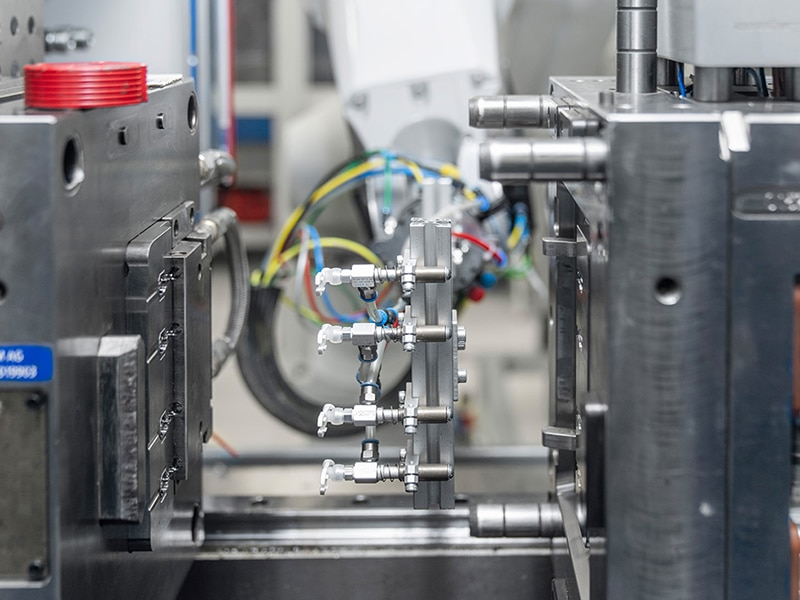
When production requirements grow, companies often need a solution that improves productivity without adding unnecessary complexity to the entire molding process. Rather than simply adding more equipment or extending production hours, stack molds focus on maximizing the capabilities of existing injection molding operations. This approach makes them especially valuable for applications where cycle time, space utilization, and consistent part quality all need to be considered. The following content will provide you with a detailed introduction to the information about the stacking molds.
What Is a Stack Mold?
A stack injection mold is an injection molding tool that contains two or more layers of cavities stacked on top of each other. The cavities of a stack mold are arranged along the mold-opening direction, which creates multiple molding surfaces inside the tool. This structure allows each cavity level to form a complete set of parts during the same injection cycle, increasing the number of parts produced each time the mold runs. Compared with a conventional injection mold that usually has one parting line with one cavity level, a stack mold increases production capacity by making better use of the available mold space.

Types of Stack Molds
Stack molds can be classified according to their structural design and the types of parts they produce. Each configuration offers different production capabilities and is suited to specific molding requirements.
Two-Level Stack Mold
A two-level stack mold contains two sets of cavity levels within the same mold structure. Both levels form parts during the same injection cycle, increasing the number of parts produced per cycle without requiring an additional molding machine. This type is commonly used for packaging components, bottle caps, and other plastic parts with high production demand.
Three-Level Stack Mold
A three-level stack mold contains three cavity levels, allowing it to produce more parts per cycle than a two-level design with comparable cavity layouts. However, the additional level increases mold complexity and requires careful consideration of mold opening stroke, runner balance, cooling, and ejection. This structure is suitable for applications that require very high output.
Cube Stack Mold
A cube stack mold uses a rotating cube mechanism to transfer parts between different molding stations. Each station can perform a specific operation, such as injection molding, cooling, or part removal, depending on the tool configuration.
Family Stack Mold
A family stack mold produces different but related plastic parts within the same molding cycle. For example, it may produce several matching components for a single product in one tool. The parts need compatible material requirements and molding conditions to ensure consistent filling and quality across the different cavities.
Difference Between Stack Molds and Conventional Molds
Choosing between a stack mold and a conventional mold depends on your production requirements and overall project goals. The following comparison highlights how these two molds differ in practical applications.
| Feature | Stack Mold | Conventional Mold |
|---|---|---|
| Cavity levels | Multiple levels | Single level |
| Output per cycle | Higher | Lower |
| Tool structure | More complex | Simpler |
| Initial investment | Higher | Lower |
Key Design Considerations for Stack Molds
A stack mold consists of several key mold parts, including the cavity and core system, runner system, ejection system, and mold base. Because each molding level needs to operate with consistent accuracy, the structure and performance of every component require careful consideration during the tooling process.
Runner System
The runner system is an important part of stack mold development. Both cold runner and hot runner systems can be used depending on the mold structure, cavity quantity, and production requirements. A well-designed runner system helps ensure balanced material flow between different cavity levels and reduces variations in part quality.

Filling Sequence
The filling sequence requires careful consideration, especially in cold runner stack mold designs. In some structures, the upper cavities are filled before the lower cavities to stabilize material flow and maintain proper material positioning. This approach helps ensure consistent part forming and smoother separation and ejection during mold opening.
Ejection System
The ejection system is another key factor in stack mold performance. Since multiple cavity levels operate within the same tool, the ejection mechanism needs to remove parts smoothly from each molding surface. Air ejector systems can be used in certain applications to improve demolding efficiency and reduce the risk of part damage.
Material Selection
Material selection affects the filling behavior, cooling requirements, and processing conditions of a stack mold. Materials with good flowability, stable shrinkage characteristics, and suitable thermal properties can help maintain more consistent filling and reduce variations between cavities.
Benefits of Stack Molds
Stack molds offer practical advantages for injection molding projects that require high output and stable production.
Higher Production Efficiency
Stack molds produce multiple sets of parts during a single injection cycle, increasing output without requiring additional cycles for each set. This helps shorten overall production time and supports high-volume projects with demanding delivery schedules.
Reduced Cost Per Part
By increasing the number of parts produced per cycle, stack molds can spread machine operating costs across more parts. This can lower the cost per part in high-volume production, especially when the mold runs consistently over long production periods.
Better Space Utilization
Stack molds increase production capacity within a single mold structure, allowing more parts to be produced without adding another injection molding machine. This can help make better use of available machine capacity and production floor space.
Improved Consistency
Producing parts within the same tooling system helps maintain consistent molding conditions across production runs. A well-designed stack mold supports balanced material filling, effective cooling, and reliable ejection at each cavity level. These factors help reduce variations in dimensions and part quality.
Challenges and Limitations of Stack Molds
The additional molding levels increase the complexity of the tooling system, making stack molds more demanding to implement and operate than conventional molds.
Higher Initial Tooling Cost
Stack molds have more complex structures than conventional molds, requiring additional components and more detailed engineering. Their design, machining, assembly, and testing can increase the initial tooling cost. For projects with low production volumes or frequent design changes, this investment may take longer to recover.
Part Geometry
Since a stack mold contains multiple cavity levels within the same tool, the cavity layout and available mold space place limitations on the size and structure of the molded parts. Parts with very large dimensions or complex features may require additional evaluation to ensure proper filling, cooling, and ejection.
More Maintenance Requirements
Multiple cavity levels, runner systems, and ejection mechanisms require regular inspection to maintain stable production. Wear, material buildup, or uneven cooling can affect part quality and production efficiency. Routine cleaning, lubrication, and checks of critical components help prevent unexpected downtime and maintain consistent molding performance.
Higher Equipment Requirements
Stack molds require injection molding machines that can accommodate the mold’s overall dimensions, weight, opening stroke, and clamping force. The injection unit must also provide sufficient capacity to fill all cavity levels properly. If the existing machine cannot meet these requirements, equipment upgrades or a different machine may be necessary, increasing overall production costs.
Common Applications of Stack Molds
The versatility of stack molds allows them to be used for a wide range of plastic components across different industries.

- Packaging industry: Stack molds are commonly used to produce bottle caps, container lids, and closures, where large quantities of similar parts are needed.
- Medical components: Applications include plastic housings, trays, and other molded components used in medical devices and supplies.
- Consumer electronics: Stack molds can produce small plastic parts such as connector housings, button caps, and device enclosures.
- Automotive components: Typical applications include interior trim pieces, plastic clips, covers, and other components used in vehicle assembly.
Conclusion
If your application involves large production volumes and a need to improve manufacturing efficiency, a stack mold can be a valuable option. The key to achieving the advantages of stack molding is not simply adding more cavity levels, but ensuring that the mold structure, runner system, cooling design, ejection method, and molding equipment work together effectively.
With expertise in injection mold design and manufacturing, we help customers evaluate whether a stack mold is suitable for their applications and develop tooling solutions based on specific production requirements, part characteristics, and performance expectations.