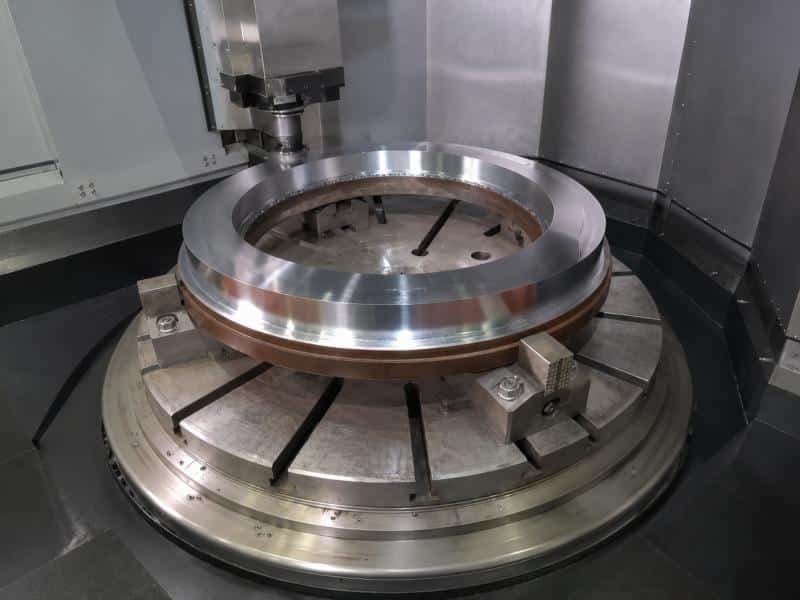
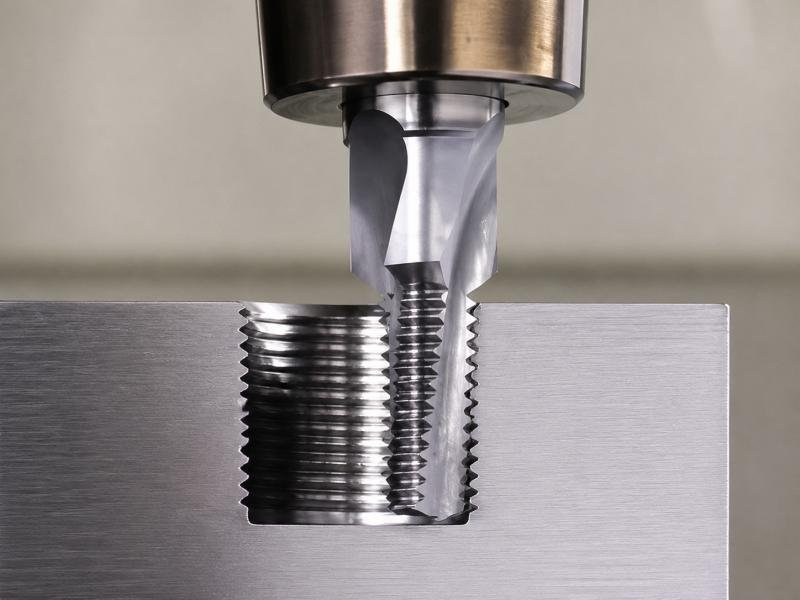
Thread machining is a specialized operation within CNC machining. Unlike standard cutting operations, thread machining requires precise control of the thread profile, pitch, depth, and alignment to ensure proper engagement between components. Understanding the different machining methods and their applications can help determine the most suitable approach for a specific part requirement.
What Is Thread Machining
Thread machining utilizes specialized cutting tools to precisely remove material and form continuous helical grooves on either the internal or external surfaces of a workpiece. These threads enable components to be securely fastened, fine-tuned, or assembled in mechanical systems. The performance of CNC machining plays a key role in determining thread quality and production efficiency. With continuous advancements in CNC technology, threading machining can achieve higher levels of accuracy, repeatability, and consistency, resulting in more reliable threaded components.
Types of Machining Thread
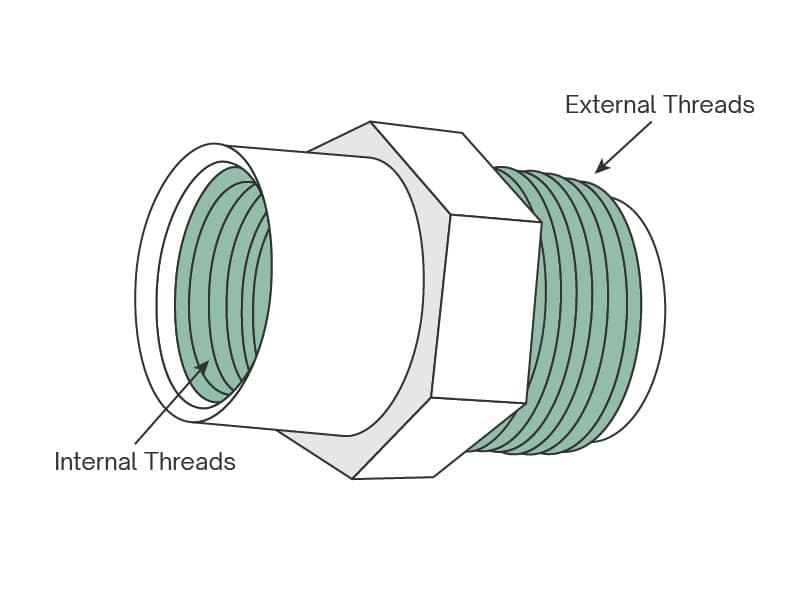
There are different types of threads based on their standards, profiles, and applications. However, from a machining perspective, they are mainly divided into two categories: internal threads and external threads.
Internal Threads
Internal threads are machined on the inner surface of a hole to allow components such as screws, bolts, or studs to be securely installed. They are commonly used in parts where fasteners need to be placed inside the component.
How to Cut Internal Threads
Internal thread machining begins with creating a properly sized hole in the component. The hole diameter must be carefully determined based on the required thread specification to ensure that enough material remains to form an accurate thread profile. Then a cutting tool called a tap is used to form threads in a drilled hole while maintaining precise alignment to prevent thread deformation or misalignment.
Compared with external threads, internal threads can be more challenging because the cutting tool works inside the part, where access is limited, and chip removal is more difficult, which may affect thread accuracy and surface quality. For this reason, internal threads often require closer process control and may involve more complex machining considerations than external threads.
External Threads
External threads are formed on the outer surface of cylindrical components. They are designed to engage with internal threads and create secure mechanical connections between parts.
How to Cut External Threads
Before cutting the thread profile, the edge of the workpiece is typically prepared by removing sharp edges and creating a chamfer. The chamfer helps guide the cutting tool into the material smoothly, and its size should be greater than the thread depth to ensure proper thread formation.
The threading process is usually completed through multiple cutting passes, with each pass gradually removing material until the specified thread depth and dimensions are achieved. Compared with internal threads, external threads generally have better tool accessibility and easier chip removal. This often allows for more efficient processing and easier control of thread dimensions during machining.
Common Thread Machining Methods
Thread machining is a crucial CNC service. Depending on your part design, material specifications, required tolerances, and budget, several advanced thread-cutting methods are available to suit your project.
Thread Milling
Thread milling is a versatile CNC method that uses a rotating milling cutter and a multi-axis machining center to produce internal and external threads. The cutter moves along a helical path through coordinated movement of the machine axes, allowing it to create threads with fast processing speeds.
Compared with traditional methods, thread milling provides greater flexibility because the same tool can often be used for different thread diameters and to produce both left-hand and right-hand threads while maintaining the same pitch. The cutting process can also remove material gradually and achieve clean thread profiles with minimal burr formation and improved dimensional control. It is an ideal option when custom thread sizes, multiple thread diameters, or complex thread designs are required.

Tapping
Tapping is often a cost-effective choice for standard internal threads with high production volumes, particularly in holes with smaller diameters. During this process, a tap tool cuts grooves inside a drilled hole to form the required thread profile. Compared with other threading methods, tapping has a relatively simple machining structure and straightforward operation. Its CNC automation reduces machine downtime during processing. Tapping tools are generally more affordable than many other threading tools, which helps reduce overall machining costs.
However, it may be less suitable for non-standard pitches, difficult-to-machine materials, or applications requiring extremely high precision, because its simple and fixed machining structure offers limited flexibility for complex thread designs and demanding machining conditions.

Lathe Threading
Lathe threading is commonly used for cylindrical components that require accurate and consistent thread profiles. During this process, the workpiece rotates while a cutting tool creates threads through controlled cutting passes, allowing the production of various thread types, including tapered threads, lead threads, and different pitch specifications.
Common techniques include single-point threading and rigid tapping. Single-point threading uses a cutting insert designed to match the required thread profile, providing precise control over thread dimensions and making it suitable for applications where thread accuracy and fit are critical.

Thread Grinding
Thread grinding is preferred for hardened materials and components that require extremely accurate thread profiles. Thread grinding commonly uses two main types of grinding wheels: single-line grinding wheels and multi-line grinding wheels. Each type is designed for different thread machining requirements and accuracy levels.
Single-line grinding wheels are commonly selected for applications requiring high thread accuracy, such as precision screws, thread gauges, and specialized components. Multi-line grinding wheels are often used for improving production efficiency when machining larger quantities.

Design Considerations for Thread Machining
When adding threaded features to a machined part, design choices can directly affect machining feasibility, cost, assembly performance, and overall part reliability. Considering the following factors early in the design stage can help avoid unnecessary processing difficulties.
Select Standard Thread Sizes
Whenever possible, choose standard thread sizes instead of custom specifications. Standard threads usually require readily available tools and inspection equipment, which can help reduce machining time and avoid additional tooling costs.
Add Proper Chamfers and Countersinks
Threaded features with proper chamfers or countersinks can improve tool entry, reduce the risk of thread damage, and make assembly smoother. If these features are not included in the original design, additional machining considerations may be required.
Maintain Sufficient Wall Thickness
For hollow or tubular components, adequate material around the threaded area helps the part withstand machining forces and maintain structural strength during use.
Match Function of Parts
Thread dimensions should match the functional requirements of parts. Excessively deep threads may increase machining difficulty without providing additional benefits, while properly designed thread engagement can provide sufficient connection strength.
Conclusion
Selecting the right thread machining method and applying sound design practices are key to achieving threaded parts that perform reliably in real-world assembly and use. As a professional CNC machining provider, we offer high-quality CNC machining services with advanced equipment and strict quality control, helping customers turn their designs into precision-engineered and dependable parts. Contact us today to discuss your thread machining needs and get a quote.