
When producing large plastic molding parts with complex structures, whether for automotive panels, industrial housings, or medical equipment enclosures, since these products are substantial in size yet produced in low volumes, the manufacturing costs for their structural components are high. Here, we will explore the key design strategies and manufacturing methods for large plastic molding parts.
Understanding Large Plastic Molding
Large plastic molding typically refers to plastic parts with dimensions exceeding 300mm and wall thicknesses greater than 3mm. The two most critical challenges in large plastic molding are warpage control and assembly precision. As part dimensions increase, manufacturing tolerances and shrinkage deformation become significantly more pronounced. Therefore, proper locating features and fit tolerances must be carefully considered during the design phase.
Use robust structures such as double-lip or dual-stop designs to improve positioning accuracy and minimize step differences (flushness issues) during assembly.
Due to inherent tolerances and potential deformation, it is advisable to incorporate relatively large gaps between mating shells. This helps maintain a uniform and aesthetically pleasing appearance even when minor variations occur.
White is often preferred for large housings because it shows dirt and minor surface imperfections less than darker colors. In many cases, a natural glossy finish or a simple clear coat is sufficient to enhance appearance without the need for extensive secondary finishing.
Manufacturing Processes for Large Plastic Molding
Large plastic molding projects require different manufacturing processes depending on production volume, budget, lead time, and part requirements. Here are the most commonly used techniques for producing large plastic parts:
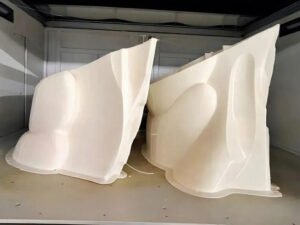
3D Printing
Ideal for rapid prototyping and initial design validation of large plastic parts. It offers quick turnaround and design flexibility but is generally limited to low-volume testing due to material performance and surface finish constraints. Not suitable for final production of functional large parts.
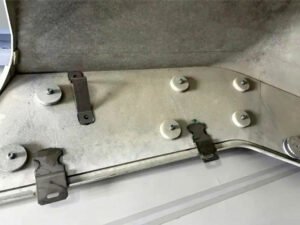
CNC Machining
Provides high precision for prototypes and small batches (typically fewer than 5 pieces). It can produce accurate large plastic components from solid blocks and allows the addition of complex features through bonded inserts. Higher material waste and longer machining time make it less economical for larger quantities.
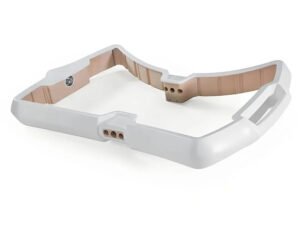
Silicone Mold Casting (Vacuum Casting)
Also known as vacuum casting or polyurethane casting. For low-volume production ranging from 10 to 20 pieces, silicone mold casting, also known as vacuum casting, is an effective method. This process replicates the features and precision of injection-molded parts, making it ideal for plastic molding large parts in small batches. The quality of the final pieces is highly dependent on the accuracy of the original prototype, and each silicone mold typically produces no more than 20 parts.

RIM (Reaction Injection Molding / Low-Pressure Pouring)
Uses low-pressure casting with aluminum tooling. It is well-suited for medium volumes (hundreds of pieces) and excels at producing thick-walled large parts with minimal shrinkage and lower tooling costs compared to traditional injection molding. Good balance of quality and economy.
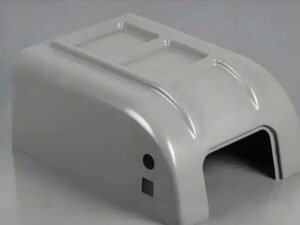
Thermoforming (Thick-Sheet Vacuum Forming)
Involves heating thick plastic sheets and forming them over molds using a vacuum. It is one of the most cost-effective methods for simple, large geometries with generous draft angles. Internal features are limited and often require secondary bonding of locators or reinforcements.
Injection Molding (Large Part Injection Molding)
The preferred process for high-volume production of large plastic molding parts. It delivers excellent surface finish, tight tolerances, complex geometries, and consistent quality. Requires high-tonnage machines and significant upfront tooling investment, making it ideal when volumes reach thousands of units.
Common Applications of Large Plastic Molding
Large plastic molded parts are widely used across various industries where durability, lightweight design, and cost efficiency are essential.
- Medical Equipment: Housings and enclosures for large medical devices such as imaging systems, diagnostic machines, and hospital beds.
- Industrial Machinery: Protective covers, equipment housings, and structural components.
- Automotive and Transportation: Large interior panels, engine covers, bumper subsystems, and charging station enclosures.
- Electronics and Telecom: Server racks, outdoor cabinets, network equipment housings, and large electronic device shells.
- Consumer Goods: Large appliance casings, sports equipment housings, and outdoor equipment shells.
Conclusion
Large plastic molding requires a careful balance of structural integrity, dimensional stability, aesthetic quality, and cost efficiency. By applying the right design principles and selecting the most suitable manufacturing process according to volume and requirements, it is possible to produce large plastic parts that are robust, visually appealing, and economically viable.
Erye specializes in delivering high-quality large injection molded components. From design support and process optimization to reliable production, we help our clients reduce costs while achieving high-quality fit and finish. If you have a project involving large plastic parts, feel free to contact Erye. We are ready to provide tailored molding solutions for your specific needs.