
When custom plastic components, we often see a machine parameter, such as a “100-ton press” or a “500-ton giant”. In plastic injection molding, machine tonnage (clamping force) is not just a technical spec. It is a critical factor that directly dictates per-part piece price, tooling longevity, and final product quality. Choosing the wrong tonnage can lead to costly part defects or unexpected tooling repair costs.
What is Injection Molding Machine Tonnage?
Injection molding machine tonnage represents the clamping force required to keep the two halves of an injection mold securely closed during the high-pressure injection cycle. It is typically measured in U.S. tons or kilonewtons (kN). When the molten plastic is being injected into a mold cavity at pressures up to 20,000 psi, the liquid plastic is trying to push the mold open. If the machine’s clamping force (tonnage) is too low, the mold halves will separate slightly, causing the plastic to leak.
Injection molding machines are categorized by this tonnage rating, ranging from precise 30-ton micro-molding presses to massive 4,000-ton hydraulic machines engineered for automotive bumpers or hot tubs.
The Quality Risk of Improper Tonnage Selection
The cost of getting the wrong tonnage choice is huge.
The Clamping Force is Too Low (Under-Tonnage)
If the machine doesn’t have enough tonnage to hold the mold closed.
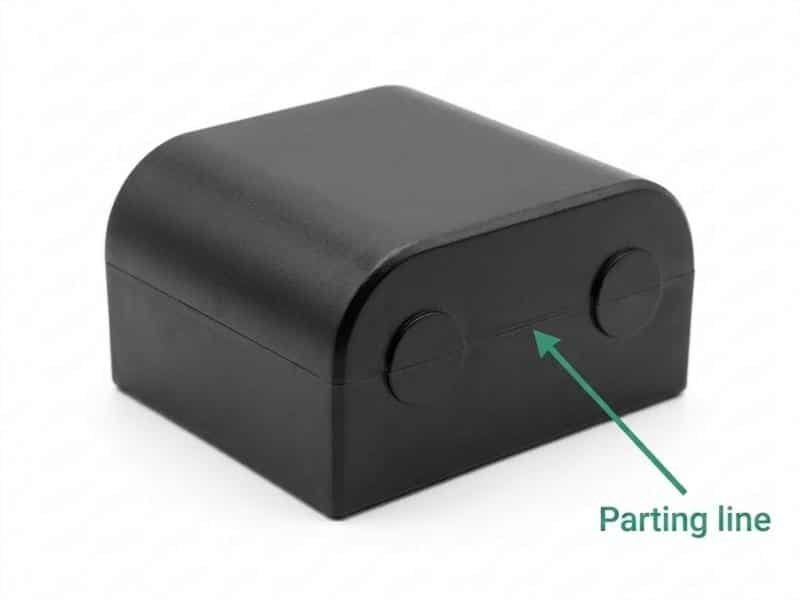
- Flash (Burrs): Excess plastic escapes along the parting line, requiring manual trimming and increasing scrap rates.
- Dimensional Instability: The slight parting of the mold alters the thickness and critical tolerances of the part.
The Clamping Force is Too High (Over-Tonnage)
Many buyers mistakenly think “bigger is always safer.” However, running a small mold on an excessively large machine causes:
- Crushed Mold Vents: Over-clamping seals off microscopic air vents, leading to trapped gases and burn marks on the plastic parts.
- Tooling Deformation: Excessive pressure can warp the mold plates, leading to premature tool failure and costly maintenance.
- Inflated Part Cost: Larger machines consume more energy and carry higher hourly rates, unnecessarily driving up the piece price.
What Influences Your Tonnage Requirement?
Calculating the ideal machine tonnage is a balancing act between four primary variables:
Projected Area of the Part
The projected area is the single largest factor in the tonnage equation. It is the 2D surface footprint of the entire part and runner system as viewed from the direction of the mold opening. The larger the surface area facing the machine platens, the more force the molten plastic exerts to push the mold open, requiring a significantly higher machine tonnage to keep it clamped shut.
Plastic Material Viscosity (Flow Rate)
Different polymers behave differently under heat and pressure. Low-viscosity materials like Polypropylene (PP) and Polyethylene (PE) flow easily, requiring lower injection and clamping pressures. Conversely, high-viscosity engineering plastics—such as Polycarbonate (PC), Nylon (PA), and any glass-filled resins—highly resist flow. They require high injection pressures to fill the mold, which demands a high injection molding machine tonnage.
Part Wall Thickness
Many product designers think thicker parts require larger machines, but the opposite is often true in injection molding. Thin-walled parts (under 1.5mm) freeze very fast inside the mold. To fill the cavity before the plastic solidifies, the machine must inject the material at high speeds and pressures, which means high clamping force and injection molding tonnage requirements.
Flow Ratio (L/T Ratio)
The Flow Ratio represents the longest distance the molten plastic must travel from the gate (L) divided by the wall thickness (T). If the product design has a high flow ratio—meaning the plastic has to pass a long path through narrow channels to fill the edges—the pressure inside the cavity will be huge. This requires sustained high packing pressures, forcing you into a higher machine tonnage bracket.
How to Calculate Injection Molding Tonnage (Rule of Thumb)
Professional injection molding manufacturers utilize advanced Moldflow analysis for precision calculations and can also use a reliable industry rule of thumb.
Tonnage (tons)=Projected Area (in²)×Clamping Pressure (psi)/2000
Where:
- Projected Area is the total surface area of the part facing the mold halves.
- Clamping Pressure depends on material type and injection parameters.
Source / Reference Basis: Injection Molding Handbook by Dominick V. Rosato, Donald V. Rosato, and Marlene G. Rosato.
Step-by-Step Approach:
- Measure the projected area of the part or mold cavity.
- Determine the recommended clamping pressure for the chosen material.
- Multiply the projected area by the clamping pressure to get the required force.
- Adjust for multiple cavities or complex part geometries if necessary.
For example, a part with a projected area of 50 in² made from ABS (clamping pressure 5,000 psi) would require: 50×5000/2000=125 tons
Engineering Note: Always add a 10% to 20% safety margin to prevent running the machine at its absolute mechanical limit. In this case, a 160-ton or 180-ton press would be the perfect match.
Conclusion
The optimal injection molding machine tonnage is a bridge between product design and manufacturing reality. Correct tonnage calculation not only secures tight dimensional tolerances and pristine cosmetic finishes but also extends tooling life and prevents unnecessary cost on oversized equipment. Erye can achieve the most efficient tonnage requirements by executing a thorough Design for Manufacturability (DFM) review, optimizing gate locations, wall thicknesses, and resin selection. Are you concerned about potential defects or looking to optimize your production costs? Contact Erye today for a DFM analysis and a tailored solution for your project.