PTFE Plastic Manufacturing Guide

Polytetrafluoroethylene (PTFE) is a high-performance fluoropolymer known for its exceptional chemical resistance, ultra-low friction, non-stick properties, and wide operating temperature range.
Content
    Add a header to begin generating the table of contents

    What Is PTFE – What Does PTFE Stand For?

    PTFE stands for Polytetrafluoroethylene. It is a fluoropolymer composed of carbon and fluorine atoms. The strong carbon-fluorine bond gives PTFE outstanding resistance to chemicals, heat, moisture, and environmental degradation.
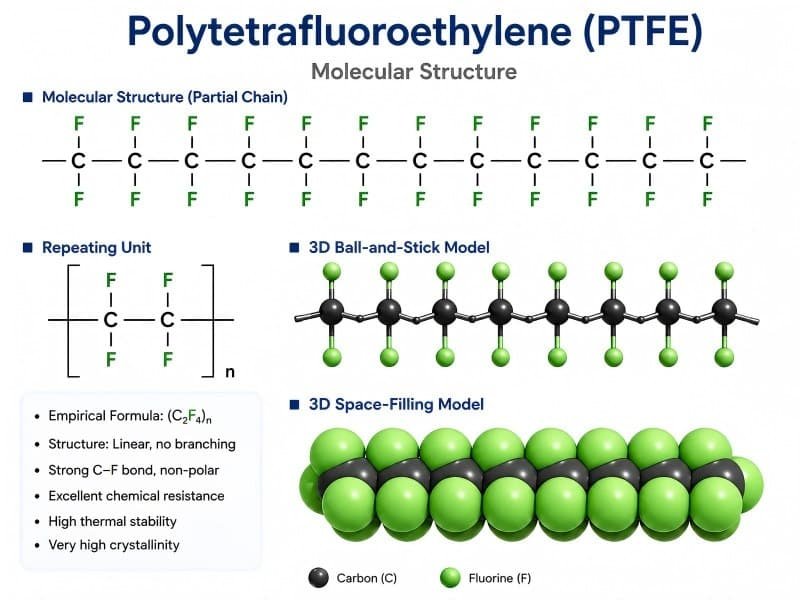
    ptfe molecular structure

    PTFE is widely recognized under the trade name Teflon®, although many manufacturers produce PTFE materials. PTFE is generally considered a high-performance engineering plastic and is often selected when conventional thermoplastics cannot meet operating requirements.

    Different Types of PTFE

    Several PTFE grades are available to meet different performance requirements.

    Virgin PTFE

    Pure PTFE without fillers. Provides the highest chemical resistance, lowest friction coefficient, and best electrical insulation properties.

    Glass-Filled PTFE

    Contains glass fibers to improve wear resistance, dimensional stability, and compressive strength.

    Carbon-Filled PTFE

    Offers improved wear resistance and thermal conductivity while maintaining good chemical resistance.

    Bronze-Filled PTFE

    Provides enhanced strength, hardness, and wear resistance for bearing and sealing applications.

    Graphite-Filled PTFE

    Designed to reduce friction and improve performance in dynamic sealing and sliding applications.

    Properties and Features of PTFE

    PTFE combines chemical resistance, thermal stability, and extremely low friction, making it one of the most unique engineering plastics available.

    Physical Properties of PTFE

    • Extremely low coefficient of friction
    • Non-stick surface characteristics
    • Exceptional chemical resistance
    • Excellent weather resistance
    • Excellent UV resistance
    • Near-zero moisture absorption
    • Outstanding electrical insulation
    • Excellent aging resistance
    • Low surface energy
    • High purity and cleanliness

    Chemical Properties

    • Strong acids: Excellent
    • Strong alkalis: Excellent
    • Salt solutions: Excellent
    • Industrial chemicals: Excellent
    • Solvents: Excellent
    • Oils and greases: Excellent
    • Hydrocarbons: Excellent
    • Oxidizing agents: Good to Excellent (depending on concentration)

    Mechanical Properties of PTFE

    • Density: 2.14 – 2.20 g/cm³
    • Tensile Strength: 20 – 35 MPa
    • Tensile Modulus: 0.4 – 0.8 GPa
    • Elongation at Break: 200 – 500 %
    • Flexural Modulus: 0.4 – 0.8 GPa
    • Shore D Hardness: 50 – 65
    • Compressive Strength: 10 – 30 MPa
    • Coefficient of Friction: 0.05 – 0.10

    Thermal Properties

    • Melting Temperature: 327 °C
    • Continuous Service Temperature: Up to 260 °C
    • Short-Term Exposure Temperature: Up to 300 °C
    • Thermal Conductivity: 0.20 – 0.35 W/m·K
    • Coefficient of Thermal Expansion: 100 – 150 ×10⁻⁶ /°C

    Electrical Properties of PTFE

    • Dielectric Constant: 2.0 – 2.2
    • Dielectric Strength: 50 – 100 kV/mm
    • Volume Resistivity: >10¹⁸ Ω·cm
    • Surface Resistivity: >10¹⁷ Ω

    Advantages & Disadvantages of PTFE Plastic

    PTFE is often selected when conventional plastics such as PP, PVC, ABS, or Nylon cannot meet demanding operating conditions. Understanding both its strengths and limitations helps engineers determine whether PTFE is the right material for a specific application.

    Advantages of PTFE Plastic

    PTFE is resistant to almost all industrial chemicals, including strong acids, strong alkalis, solvents, fuels, and corrosive fluids. It maintains its properties even during long-term chemical exposure, making it common for seals, valve seats, pump components, and chemical processing equipment.
    PTFE has one of the lowest coefficients of friction of any solid engineering material. For bearings, bushings, wear pads, and guide components, it helps reduce operating torque, minimize energy loss, and prevent sticking.
    PTFE can continuously operate at temperatures up to approximately 260°C while maintaining chemical resistance and electrical performance.
    PTFE offers excellent dielectric properties across a wide frequency range and remains electrically stable even in humid or chemically aggressive environments.
    PTFE is highly resistant to ultraviolet radiation, moisture, and environmental aging, helping outdoor industrial equipment achieve long service life.

    Disadvantages of PTFE Plastic

    Virgin PTFE provides excellent sliding performance but can wear relatively quickly under high contact pressures or abrasive conditions. Filled PTFE grades are often required for demanding dynamic applications.

    PTFE expands and contracts more than many engineering plastics as temperatures change. For precision components with tight tolerances, thermal expansion must be considered during design.

    PTFE is significantly more expensive than commodity plastics such as PP, PE, ABS, or PVC. Many PTFE components also require compression molding and secondary machining rather than conventional injection molding.

    PTFE Plastic Manufacturing Process

    PTFE requires different processing methods than conventional thermoplastics because it does not flow like standard injection molding materials.

    PTFE Plastic Applications

    PTFE is commonly used for parts that require chemical resistance, low friction, high-temperature performance, or electrical insulation.

    Typical applications include:

    • Seals, gaskets, and valve seats.
    • Bearings, bushings, and wear pads.
    • Chemical processing equipment components.
    • Pump, valve, and fluid handling parts.
    • Electrical insulators and high-frequency components.
    • Medical, food-processing, and laboratory equipment parts.
    ptfe injection molding
    ptfe injection molding
    ptfe compression molding
    PTFE Compression Molding

    Materials Similar to PTFE and How to Choose

    PTFE vs UHMWPE

    PTFE Plastic Material FAQs

    Standard PTFE is generally not processed using conventional injection molding because it does not melt and flow like typical thermoplastics. Most PTFE parts are manufactured through compression molding and CNC machining.

    PTFE is one of the most heat-resistant engineering plastics available. It can continuously operate at temperatures up to approximately 260°C (500°F) while maintaining chemical resistance and electrical insulation properties.

    Yes. PTFE provides excellent dielectric strength, high volume resistivity, and stable electrical performance across a wide temperature and frequency range. It also maintains insulation performance in humid and chemically aggressive environments.

    The best choice depends on the operating environment and performance requirements. In general, PTFE is preferred for chemical and high-temperature applications, while UHMWPE is often selected for wear and impact applications.

    PTFE is a plastic, not a rubber. More specifically, PTFE is a high-performance fluoropolymer belonging to the thermoplastic family. Unlike rubber materials such as Silicone, EPDM, NBR, or Viton, PTFE is rigid and does not provide elastic sealing force.

    PTFE and Teflon are not exactly the same thing, but they are closely related. PTFE is the generic material name, while Teflon® is a trademark originally introduced for PTFE-based materials.

    Related Resources of PTFE Plastic Manufacturing

    Plastics for medical devices provide enabling safer, more cost-effective, and customizable solutions compared to traditional

    Ultraviolet (UV) radiation from sunlight causes gradual degradation in many plastic materials. This process, known

    Dimensional control is a central concern in injection molding. Even when the mold is precisely

    Plastics have become a primary material in modern vehicle manufacturing. The use of automotive plastic

    Polymer materials are BY FAR the most unique materials in modern manufacturing. You see them

    In the food and beverage industry, safety is paramount. Every component that comes into contact